
Key Takeaways
- Prices are real, execution is simulated: forex demo accounts use live market price feeds, so the rates you see are genuine, while the fills, spreads, and rejections are modelled.
- Five gaps to plan for: slippage, variable spreads, psychology, stop-loss fills, and overnight swap charges behave differently once real money is involved.
- The loss data is sobering: across 14 FCA-authorised UK brokers, the mean retail loss rate was 69.9% in April 2026, with individual firms reporting between 51% and 82%.
- Demo profit is a strategy test: it tells you whether your rules have logic behind them, but very little about whether you are ready to trade your own capital.
- Switch on evidence: around 100 explained trades, a written strategy, and knowledge of your broker's real costs are better indicators than a rising virtual balance.
If you have turned $10,000 of virtual money into $13,500 over a few weeks, your strategy may be sound. But a funded account can still behave differently. This is because spreads widen at the worst moments, and orders fill a few points from the price you clicked. The same setups that worked in practice start losing, and the obvious conclusion is that the market has turned or the broker is interfering. But the actual reason is the friction that forex demo accounts leave out.
This guide covers the five differences that explain most of it, what practice accounts do get right, and how to know when you are ready to fund one.
What Is a Forex Demo Account?
A forex demo account is a practice account funded with virtual money, sometimes called paper trading. Your broker gives you the real trading platform, connects it to actual market prices, and lets you place orders without risking anything. Most are free, come preloaded with around $10,000 to $100,000 in virtual funds, and stay open indefinitely.
You can find out where the order button is, discover what a pending order does, and test whether an idea holds up, all without paying for the education in actual losses. Judged by this purpose, demo accounts work well.
Are Forex Demo Accounts Accurate?
The prices are accurate because your demo is connected to the same live feed as everyone else. If EUR/USD is quoted at a particular rate in your practice account, that is the actual market rate at that moment.
The accuracy problem comes after you click. In a demo, an order to buy at 1.0850 fills at 1.0850, instantly, every time, whatever the market is doing. In a live account, the same order might fill a few points away during a quiet session, or come back as a requote while a central bank is speaking. This gap between accurate prices and accurate fills is where most people first notice the difference between demo account and live account trading.
Five Ways Forex Demo Accounts Differ From Live Trading
There are five differences between the two, and these keep compounding. Each one is small on a single trade and significant across a few hundred, which is why demo results tend to flatter a strategy.
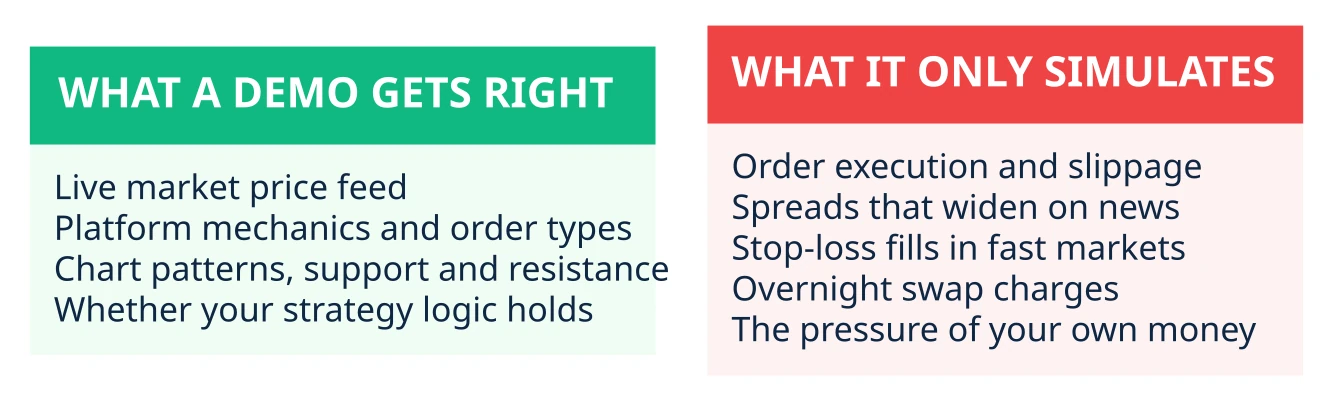
Figure 01. What a demo reproduces faithfully, and what it only approximates.
1. Slippage
Slippage in forex is the difference between the price you asked for and the price you got. It happens in live markets whenever the price moves between your click and your broker filling the order, which is common around news releases and during quiet overnight hours when fewer buyers and sellers are available. Demo accounts usually remove this.
Your entry fills where you clicked, and your stop fills exactly where you placed it. On a strategy using a 30-pip stop, losing two or three pips per trade to slippage changes the maths considerably over fifty trades, and none of this shows up in practice results.
Our team has seen this whenever we have run the same strategy on a demo account and a live account side by side. On quiet days, the two accounts track each other closely, and the results look almost identical. Around major news releases, such as the US jobs report or a central bank decision, the live account starts to fall behind. Orders fill a few pips away from the price on screen, spreads widen for a while, and stop-losses close trades at worse levels than planned. The demo doesn't show any of this, which is why you should test a strategy on a small live account before trusting its demo results.
2. Spreads That Move
The spread is the gap between the buy price and the sell price, and this is how many brokers earn their money. Demo accounts generally apply the broker's advertised spread, which is the figure measured under good conditions.
On the other hand, live forex spreads move. A pair quoted at 0.6 pips during the busy London and New York overlap can widen sharply during a rate decision or in the thin hours after New York closes. For anyone trading short-term moves, this difference can be the whole edge. A system that looks profitable at 0.6 pips may break even at 1.5. Checking a broker's real spreads before funding is a must and our broker comparison tool exists for exactly that.
3. Forex Trading Psychology
Losing virtual money just registers as a number changing on a screen. The urge to move a stop further away, to add to a position that is already down, or close a winner early before it turns - all get much stronger when the actual money is involved.
The scale of that difficulty shows up in the regulator's own data. Analyses by EU national authorities found that 74% to 89% of retail CFD accounts lose money, with average losses per client between €1,600 and €29,000 (ESMA, 2018). These figures answer why every regulated broker now has to display a loss percentage on its own homepage.
"If you are unable to trade without the slightest bit of emotional discomfort (specifically, fear), then you have not learned how to accept the risks inherent in trading. This is a big problem, because to whatever degree you haven't accepted the risk, is the same degree to which you will avoid the risk."
— Mark Douglas, author of Trading in the Zone
Knowing you should cut a losing trade is a different thing from pressing the button while your own savings drain away. A demo cannot teach that, because there is nothing at stake.
4. Stop-Loss Fills
In a demo, a stop at 1.0800 closes your trade at 1.0800. In a live market during a sharp move, the price can jump straight past that level, and your stop closes at whatever price was available.
This is ordinary market behaviour. There was just no one willing to trade at your price at that moment. So, the strategies built around very tight stops suffer most when markets move fast, which is when they are supposed to protect you.
5. Overnight Swap Charges
Holding a position past the daily rollover point incurs a swap charge, which is a financing cost based on the interest rate difference between the two currencies. Demo accounts often show these at the wrong level, and sometimes leave them out completely.
For a trade closed within the day, this changes nothing. On a position held for two or three weeks, the charges build up steadily and can turn a small winner into a loser. If your strategy holds trades overnight, find your broker's actual swap rates before you rely on demo profit figures.
What Forex Demo Accounts Get Right
While these accounts have certain limitations, they do the following things quite well:
Platform mechanics: Each platform has its own order types, chart tools, and quirks. Learning them costs nothing in a demo, and entering a market order when you meant a limit order is a much cheaper mistake to make with virtual funds.
Price behaviour: The market data is real, so support and resistance levels, trends, and chart patterns behave the same way they will in a funded account. In other words, technical analysis practice carries over completely.
Strategy logic: You can find out whether a rule-based system has any coherent edge. While execution quality and emotional stamina stay untested, the underlying entry and exit logic gets a fair trial.
Do Brokers Rig Demo Accounts?
This claim circulates widely in trading forums: that brokers deliberately flatter demo performance to build false confidence, then take your money once you fund an account. Here is a reality check:
Brokers authorised by the FCA in the UK, ASIC in Australia, or CySEC in Cyprus operate under rules that prohibit manipulating trading conditions, and the penalties for being caught are severe enough to make it a poor business decision. Regulated brokers offer a deliberately smooth simulation, because a practice account full of requotes and slippage would make learning more difficult than it needs to be. That is just a design limitation.
Unregulated brokers are a different matter, and in their case the demo environment is the least of your worries. You must check authorisation before opening any account, practice, or funded. UK firms are searchable by name or reference number on the FCA register. If a broker cannot be found on any register, our scam alerts section is worth reading before you go further.
When to Switch From Demo to Live Trading
Most traders worry about going live too early, but staying on a demo too long also comes with costs. Virtual profits cannot become the money you can withdraw, and after a few months, a demo stops teaching you anything new about your readiness.

Figure 02. Four checks worth clearing before you fund an account.
So, here are a few signs that will let you know when you are ready:
- Almost 100 completed trades: Across trending, ranging, and volatile conditions.
- A written strategy: A set of entry rules, exit rules, and position sizing that you could hand to someone else.
- Results that can be explained: You will know why each trade won or lost.
- Knowledge of actual costs: Your broker's spreads during news, commission per trade, and swap rates on the pairs you trade.
On the other hand, here are the reasons to stay where you are for now:
Results that swing around without explanation, a strategy you rewrite more than once a month, or a losing run you haven't sat through without changing the rules halfway.
And finally, when you fund an account, you must start much smaller than your practice size. If you traded $10,000 virtually, begin with a few hundred and size positions to match. The aim in the first month is to learn what the pressure feels like while the stakes are small enough to survive. You can compare account conditions on our best brokers list before you commit.
Mistakes to Avoid When Moving to Live Trading
These four patterns account for most of the difficulty traders report in their first funded months:
- Polishing the strategy forever: Refining a system in demo until it looks flawless, then finding that the live account behaves differently. The strategy is often fine, and the practice conditions set expectations the real market was never going to meet.
- Carrying over demo costs: A short-term system tested at 0.6-pip spreads needs rechecking at the 1.2 to 1.5 pips it will actually pay. Build the real cost in before trusting the edge.
- Using demo success to justify heavy leverage: With mean retail loss rates near 70%, a good practice run doesn't change any underlying odds. Oversized positions end more accounts than a poor strategy selection.
- Skipping practice altogether: Platform mistakes, wrong order types, and misread leverage are expensive lessons live, and free ones in a demo.
The Bottom Line on Forex Demo Accounts
Forex demo accounts are useful within a clear limit. They give you actual prices, a real platform, and a free place to test whether your rules make sense. But they leave out slippage, moving spreads, swap charges, and the pressure of trading money you need, which together account for most of the gap traders find when they go live.
So, see a profitable demo as evidence that your strategy has logic, and nothing more than that. Use it until you have a written plan and almost a hundred trades you can account for, then fund an account with a fraction of your practice size and give yourself a month to get used to how different it feels.
Frequently Asked Questions About Forex Demo Accounts
Are forex demo account prices the same as live prices?
Yes, they are the same at regulated brokers. Demo accounts connect to the same live price feed as funded accounts, so the rates on your screen are the actual market rates. The differences are in execution, spread behaviour, and psychology.
Do demo accounts have slippage?
Rarely. Most practice environments fill orders at the price displayed, without requotes. Live accounts see slippage regularly, especially around economic releases, central bank announcements, and quiet overnight sessions. This is one of the largest practical differences between the two.
How long should you practise on a forex demo account?
Until you have a written strategy and around 100 trades of consistent, explainable results across different market conditions. Most of the beginners find forex demo trading stops teaching them much after that point. That takes nearly two to four months. Staying longer has diminishing value, because once the learning curve flattens, a demo stops telling you anything new.
Can demo results predict live trading performance?
They can show whether a strategy has logical merit, though they predict live returns incorrectly. Actual spreads, genuine slippage, and the pressure of your own capital mean practice results almost always overstate what a funded account will deliver.
Why do demo profits disappear on a live account?
Three things usually explain it: wider spreads than the demo applied, slippage on entries and stop exits, and the effect of real money on your decisions. These are structural differences between the environments rather than a change in the market or a fault in the strategy.
How much virtual money do forex demo accounts give you?
Typically between $10,000 and $100,000, and many brokers let you choose the starting balance. Setting it close to the amount you actually intend to deposit makes practice far more useful, since trading $100,000 virtually teaches you very little about managing a $1,000 account.
