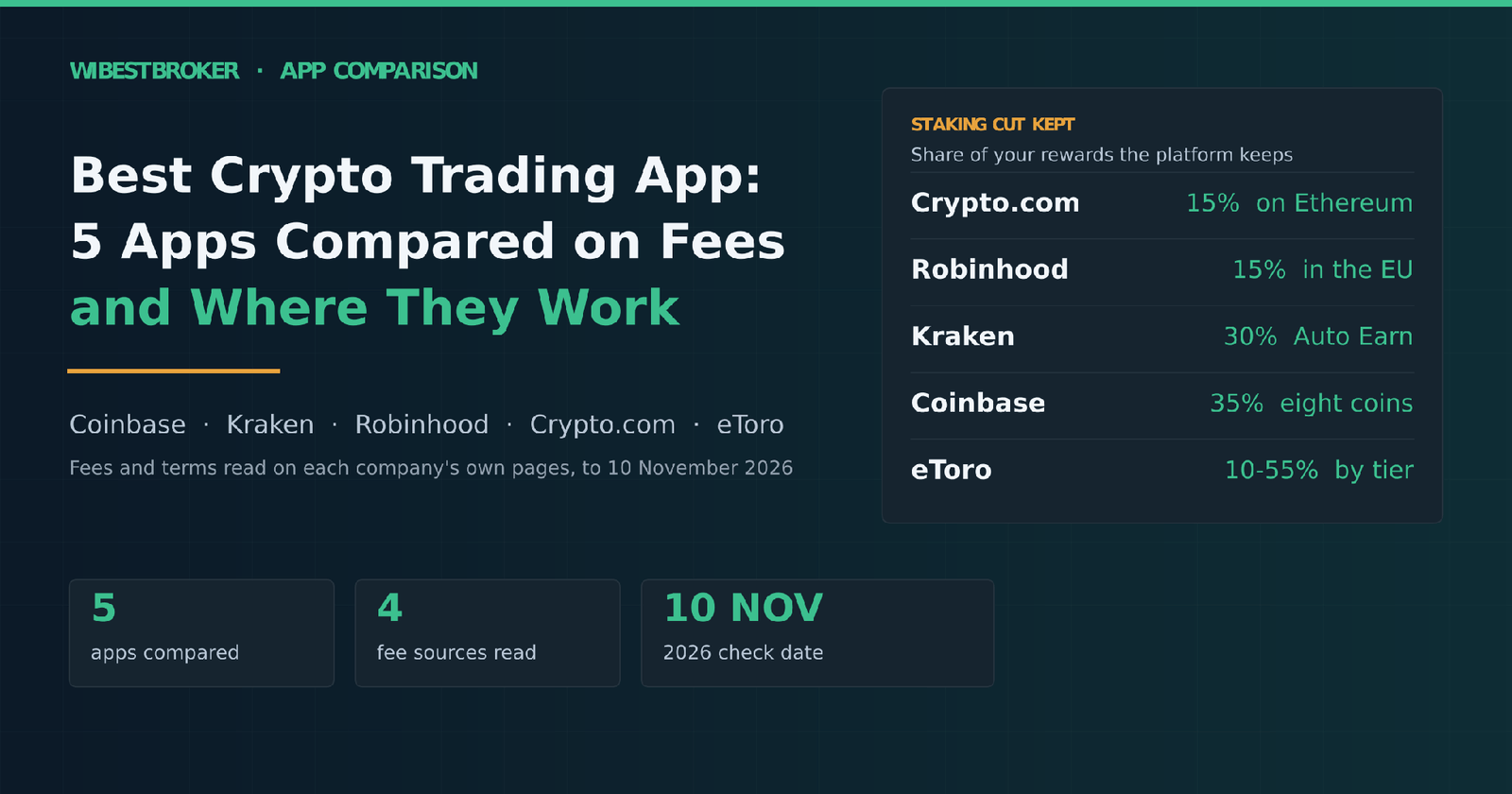
The best crypto trading app depends on what you need. Coinbase makes buying crypto easy for beginners. Kraken offers lower trading fees, Robinhood and eToro let you trade crypto alongside stocks, and Crypto.com takes the smallest cut of your staking rewards.
Pick for what you need most often, because the fee you pay follows from that, not from the star rating in the store.
Key Takeaways
- Coinbase is the easiest place to make a first purchase, and the most expensive.
- Kraken costs the least of the five, but only once you leave its instant-buy screen.
- Crypto.com keeps the smallest share of staking rewards on Ethereum.
- Robinhood and eToro suit people whose shares already sit in the same app.
- Check whether the app accepts users from your country before comparing fees.
Best crypto trading apps compared
Costs below are for a plain buy in the main app, not the advanced screen. The staking commission is the cut the company takes from your rewards, which matters more over a year than any single buy.
| APP | FOR | SIMPLE BUY COST | STAKING COMMISSION | APP STORE RATING |
|---|---|---|---|---|
| Coinbase | A first purchase | Spread in the price, plus fees by payment method | 35% on eight coins | 4.7 from 1.8M ratings |
| Kraken | The lowest running cost | 1% Instant Buy fee, plus any spread | 30% (Auto Earn) | 4.7 from 36K |
| Robinhood | Crypto and shares in one account | Spread with $0.95 per $100 to Robinhood (US) | 15% (EU, SOL and ETH only) | 4.3 from 4.9M |
| Crypto.com | Keeping more of your rewards | 0.250% maker, 0.500% taker on the Exchange | 15% on ETH, 20% on most coins | 4.7 from 336K |
| eToro | One flat fee across assets | 1% per position at lower tiers | Keeps 10% to 55% of the yield | 4.4 from 10K |
Ratings are from Apple's US App Store, and fees were read from each company's own pages, as of November 2026.
1. Coinbase: for your first purchase
Coinbase is the one to pick if it is the first crypto you plan to buy. One app holds both a simple buy screen and Coinbase Advanced, the order-book screen you move to later.
That simple screen costs more than it appears to. Coinbase builds a spread into the price you see, a simple limit order adds a 1% execution fee, and a payment-method charge of up to 1.875% can apply on top. Advanced prices on the order book instead, without a spread, though its fee page notes the fees do not apply in every region.
Where it works: More than 100 countries, as of 30 September 2026.
Watch out for: Crypto bought with cash that is still on hold cannot leave the account until the hold lifts, and support cannot shorten it.
2. Kraken: for the lowest running cost
Kraken is the cheapest of the five to trade on, as long as you do not stay on the beginner screen. A buy in the phone app, called Instant Buy, carries a fixed 1% fee plus any spread. Kraken Pro, the separate platform holding the advanced tools, charges the ordinary taker fee on a market order, a fraction of that.
Auto Earn staking is free to enter, though Kraken keeps 30% of the rewards.
Where it works: Eligibility is set country by country, and individual products are narrower than the account itself, so check Kraken's list for your country first.
Watch out for: Kraken may hold withdrawals against a recent deposit, and the wait is longer for a bank transfer than for a card.
3. Robinhood: for crypto besides shares
Robinhood makes sense when your shares already live there, and you would rather hold one app than two. A separate company, Robinhood Crypto, LLC, runs the crypto side.
In the US, the default route builds Robinhood's pay into the spread: it receives $0.95 from its market maker for every $100 of crypto orders sent that way (15 June 2026). Orders routed to exchanges pay 0.00% to 0.95% instead, falling as volume rises. In Canada, the charge is 0.95% of the order plus a spread.
Where it works: The United States and its territories, plus Canada and parts of the EU.
Watch out for: Staking is narrow. In the EU, it covers Solana and Ethereum only, with a 15% fee.
4. Crypto.com: for keeping more of your staking rewards
Crypto.com keeps 15% of staking rewards on Ethereum, against 30% at Kraken and 35% at Coinbase. It takes 20% on most other coins and 35% on NEAR and INJ, and can change those figures.
Trading is on a volume ladder. On the Crypto.com Exchange, the entry tier charges 0.250% to make and 0.500% to take, with 0% to make for holders of a large CRO balance.
Where it works: Trading is widely available; staking is not. Crypto.com excludes residents of Hong Kong, Seychelles, South Korea, Thailand, Singapore, apart from accredited investors, and five US states.
Watch out for: That 0.500% taker fee is the entry rate, and it only falls once your 30-day volume passes $10,000, which most casual buyers don’t reach.
5. eToro: for one flat fee across crypto and shares
eToro charges a flat 1% per manual crypto position at its Bronze, Silver, and Gold tiers, less at higher ones. It’s the same number, whatever you buy, which suits people who want crypto and shares in one account without learning two fee tables. Positions start from $10.
Short and leveraged positions are traded as CFDs, which track an asset’s price without giving you ownership of the actual coin. For regulatory reasons, eToro may use the same structure for some regular buy positions. Outside the US, staking covers nine coins, and you keep 45% to 90% of the yield by tier.
Where it works: Available in 75 countries. Crypto trading is unavailable in Hawaii, Nevada, Puerto Rico, and the US Virgin Islands, with a limited selection in New York.
Watch out for: Moving coins into the eToro Money wallet costs 2%, while sending them to an outside wallet carries only the blockchain fee.
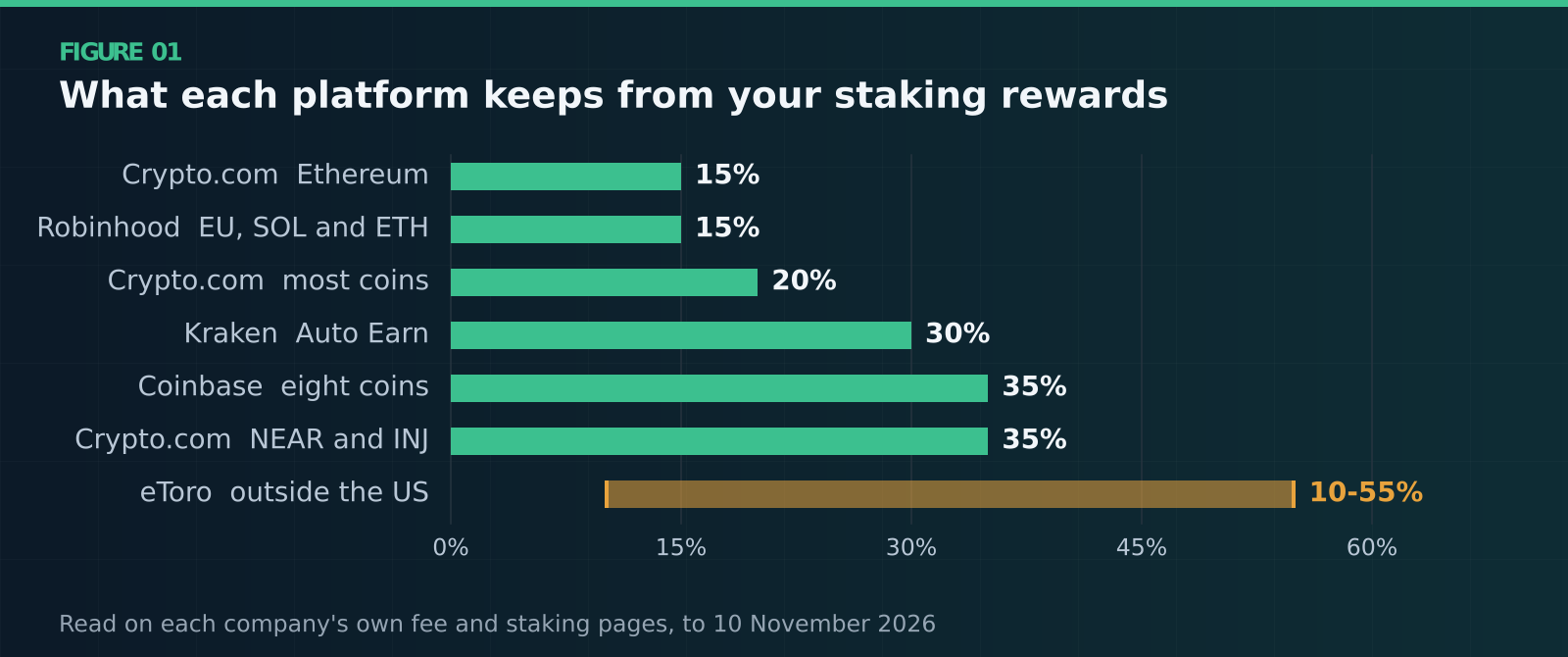
The longer the bar, the less of your staking yield reaches you.
How do you choose a crypto trading app?
Does it accept your country? The only question that can end the search outright, and the one ranking pages usually skip. Some may restrict staking or whole products.
What will you actually do? Buy monthly and hold; then the staking commission decides your return. But if you trade weekly, the per-order fee decides the return. The best crypto trading app for a long-term holder may not be the best choice for an active trader.
How will you pay? Holds do not follow the obvious pattern. Kraken locks card purchases for 72 hours, and an ACH bank buy for seven days. Even though a bank transfer may take longer to clear, it can also keep your money locked for longer.
Who is holding the coins? You are trusting a company, not a blockchain. Tuang Lee Lim, who chairs IOSCO's board-level fintech task force, put it plainly when the body issued its global recommendations for crypto firms: “The activities of CASPs and their associated risks frequently mirror those observed in traditional financial markets.” CASPs are crypto-asset service providers, which is what all five apps are.
So check the firm like you would verify a broker. Our regulation guides and the checks before a first deposit explain how to do it.
The Bottom Line on Crypto Trading Apps
If you are buying your first coin, pick Coinbase. If you are trading often enough to leave the beginner screen, then pick Kraken. If your shares are already sitting in one of them, select either Robinhood or eToro. For staking and holding, choose Crypto.com. If you do two of these in any size, two accounts usually beat one compromise.
Frequently Asked Questions
Which is the best crypto app for beginners?
Coinbase, for most people. Its buy screen asks the fewest questions, and the same app holds Coinbase Advanced, so you don’t move platforms once you want real order types. The trade-off is price, since that screen hides its cost in the quote. Kraken's app is cheaper if cost matters more than comfort.
What is the safest crypto app?
None of the five is risk-free, and the question is about the company rather than the app. The safest crypto app for you is the one that is authorised where you live, holds customer coins separately from its own, and tells in writing what happens if it fails. Check the registration before the ratings.
Is my crypto safe if a trading app goes bust?
Not reliably. FTX's 2022 collapse left more than one million customers unable to withdraw. Recovery is possible but slow, and partial in actual terms: the FTX Recovery Trust said on 18 March 2026 that allowed US customer claims had reached a 100% cumulative payout, valued at 2022 filing-date dollars. Anyone repaid got 2022 prices, not their coins.
Are crypto trading apps free to use?
No, and the ones that look free move the cost into the price you are quoted. Subscriptions narrow the bill rather than remove it. Coinbase One gives zero trading fees within its limits, but not on the 1% limit-order fee, and Kraken+ waives the 1% Instant Buy fee only up to $10,000 a month. Staking commissions sit outside both.
What is the best app to buy crypto with a bank transfer?
Any of the five accepts one where it operates, so pick based on what happens after the money lands. A transfer usually costs less than a card at the funding step, but the withdrawal hold that follows can run longer. Read the hold for your own payment method on the app's support pages before you fund the account.
Can one app be the best crypto app for both trading and holding?
Rarely, because the two cost money in different places. Trading is priced per order, so the lowest taker fee wins, which here means Kraken Pro. Holding is priced through the staking commission, so the platform keeping the least of your rewards wins, which means Crypto.com on Ethereum.