Before making your first deposit, you are just reading a website. But once you become the client of a company, it holds your money, as per the rules of the place where it is registered.
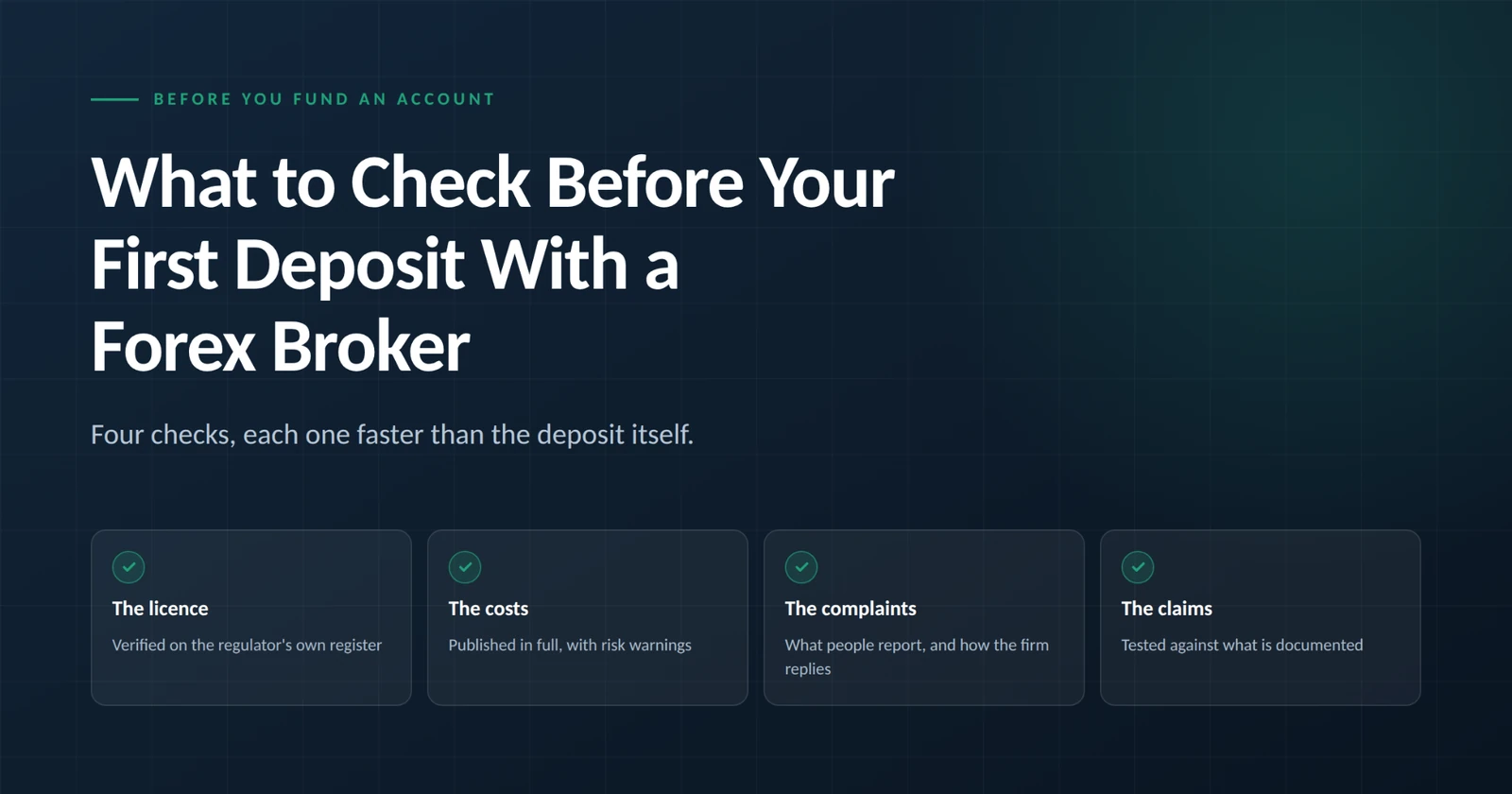
So, what should you do before making your first deposit? Four checks cover most of the risk:
- the licence, verified on the regulator's own register
- the published costs and risk warnings
- the complaint record and how the firm answers it
- the promotional claims, tested against the documentation
This guide covers how to check a forex broker before your first deposit, in that order. Each check can be done from your phone within an hour, and each one gets more complex once the money has moved.
1. Check their licence yourself
Every broker says it is regulated. On its own the word means nothing, because it does not say by whom, for what, or whether the company taking your deposit is the same one holding the licence. So, first do the following things yourself:
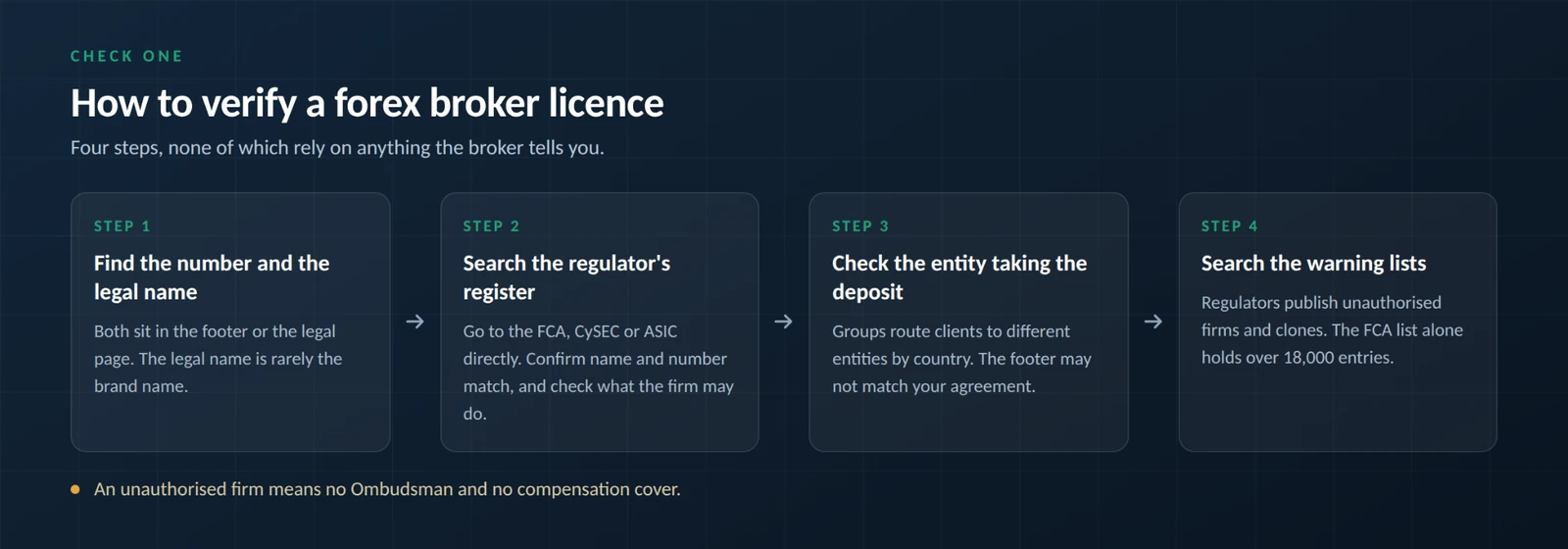
Find the licence number and the legal entity name: Both are usually in the footer or on the legal page. The legal name is rarely the brand name. A broker trading as "XYZ Markets" may be registered as "XYZ Global Services Ltd".
Look them up on the regulator's own register: Ignore the badge on the website and go to the source: the FCA in the UK, CySEC in Cyprus, ASIC in Australia, and so on. Search the name and the number and confirm they match. This is how you verify a forex broker licence without relying on the broker's own word for it. Check what the firm is permitted to do, because some licences cover advice or payments rather than holding client money.
Check which entity appears at the deposit stage: Larger groups hold several licences and route clients to whichever entity covers their country. The company in the footer may not be the company in your account agreement. Read the agreement before you sign it.
Check the warning lists: Regulators publish the names of firms operating without permission, including clones that copy a real firm's details. The FCA's Warning List alone holds over 18,000 entries. Dealing with an unauthorised firm costs you access to the Financial Ombudsman Service and to compensation cover, which is most of what a licence is worth.
This is the same verification step that comes first in how we review brokers.
2. What the costs and risk warnings should tell you
Look for five numbers: Typical spreads on the pairs you will actually trade, commission per lot, overnight or swap charges, inactivity fees, and withdrawal fees. All five belong on the website.
Watch how they are expressed: "From 0.0 pips" describes the best case, on one account type, and at one moment. A broker being straight with you publishes typical ranges, the account type they apply to, and the conditions attached.
Read the withdrawal terms before the deposit terms: Money going in is always easy. The part worth your attention is the minimum withdrawal, the processing time, the fee, and anything that changes those if you accept a bonus.
Check the risk warnings: Firms regulated in the UK, the EU and Australia must display one, and many publish the percentage of retail accounts that lose money. What a firm has to disclose depends on where it is licensed, and which the regulation guides set out regulator by regulator. A missing warning, or one in grey text at the foot of the page, tells you how that firm thinks about disclosure in general.
None of this confirms that a broker is safe. It tells you whether the firm expects you to read, which is a fair guide to how it will behave when something goes wrong.
3. Reviews, complaints and how a broker answers them
Reviews are the noisiest indicator here, so read them for pattern rather than sentiment. The clearest signs of an untrustworthy forex broker show up in what people complain about, not its average score.
Sort by the complaint, not the star rating: Platform outages and slow support are irritating. Withdrawal problems are different in kind, because that is the failure that costs you the balance. A cluster of withdrawal complaints across several independent sources is the clearest forex broker red flag on this list.
Treat perfect scores as a warning: Every broker with real volume has unhappy clients. A wall of five-star reviews posted in the same fortnight usually means they were bought.
Look at how the firm replies: A serious complaints process is visible from outside: a named route to raise something formally, a stated timeframe, and an external escalation path such as an ombudsman or the regulator. A firm that answers criticism in public, even defensively, is easier to deal with than one that never appears at all.
Check for regulator action. Past enforcement is not automatically disqualifying, but it should change how much you deposit and how soon you test a withdrawal.
One thing covers what the checks cannot: Make the first deposit a small one, trade it, and withdraw part of it early. See it as the last check rather than the finish line. A broker that pays out cleanly on a small sum has told you more than any review will.
4. Promotional claims that do not survive a check
Every claim in a promotion should be testable. Ask what would have to be true for it to hold, then look for where that is written down.
Deposit bonuses: The bonus is rarely the problem. The turnover requirement attached to it is. Some terms tie the bonus, and occasionally the deposit beside it, to a trading volume you are unlikely to reach. Find that number before you accept anything.
Guaranteed or fixed returns: No broker can promise these on a leveraged product. A firm offering them is either unlicensed or describing something other than what you think it is.
Copy-trading and signal performance: Look for the full period, including the drawdown. A track record that begins three months ago is a selection, not a record.
Influencer promotions: Check whether the commercial relationship is disclosed. If someone is paid per funded account and does not say so, what you are reading is an advertisement.
There is a pattern underneath all four. Google permits CFDs, spread betting and rolling spot forex to be advertised only by licensed firms holding its certification, and that certification is granted market by market. So, the offers reaching you through channels with no such check, direct messages, group chats, cold calls and influencer posts, have passed without filter on the way to you. That does not clear a promotion, but narrows down to where your scepticism should be.
The same four checks, from the brokerage side
The four checks look different from the other side of the table, so this last part is for anyone reading from inside a brokerage rather than outside one.
As the platforms admit only licensed firms, and certification is granted market by market, a broker can do all of this properly and still be missing from the places a trader looks, simply because it has not been approved to advertise there yet. Being trustworthy and being findable are separate problems, and the second does not solve itself.
The second problem is the work a forex marketing agency in regulated finance does: putting verifiable trust signals in front of people through search, editorial and partnerships, in markets where paid reach is restricted.
None of this substitutes for the first problem. So, read as a standard rather than a warning, the list is short, and it is the set of forex broker trust indicators a stranger can verify:
- A licence anyone can confirm in two minutes.
- Costs published in full. A complaints route that leads somewhere.
- Claims that survive being tested.
If you get those wrong, no amount of distribution can help.
The Bottom Line
The four checks take about an hour between them. The deposit is the last moment when running them is free, and the first moment when skipping them costs you something.
Frequently Asked Questions
Does a licence guarantee my money is safe?
No. It gives you rules the firm has to follow and a complaints route. Where compensation schemes exist they are capped, often well below a large balance, and they cover the firm failing rather than a trade going against you. Check the cap in your jurisdiction before assuming the whole balance is protected.
Is an offshore licence always a bad sign?
Not always, but it changes what you are relying on. Offshore regimes usually carry lighter capital requirements, weaker rules on separating client money, and little practical recourse if something goes wrong. See it as a reason to deposit less and test a withdrawal early.
What should I do if a withdrawal is refused?
Ask for the reason in writing, along with the clause it relies on. Use the firm's formal complaints process and keep every date. If that goes nowhere, escalate to the regulator that issued the licence, which is the reason the licence check belongs before the deposit rather than after it.