Before you hand money to a US-based broker, there is one check you should always run. FINRA BrokerCheck is a free, government-backed database that shows you whether a broker is actually registered, what their employment history looks like, and whether they have been sanctioned, sued, or worse. It takes about two minutes.
Most investors skip it. That's a mistake.
TL;DR: FINRA BrokerCheck (brokercheck.finra.org) is a free tool that shows registration status, employment history, qualifications, and disclosure events for US brokers and brokerage firms. Search by name or CRD number. Brokers with multiple customer disputes or unexplained employment gaps are worth investigating further before you deposit.
What Is FINRA — and Why Does BrokerCheck Exist?
FINRA (the Financial Industry Regulatory Authority) is the self-regulatory organisation that oversees broker-dealers in the United States. As of 2026, it supervises approximately 3,300 brokerage firms and over 625,000 licensed representatives (FINRA 2024 Industry Snapshot). Congress authorised FINRA to regulate the securities industry under the Securities Exchange Act of 1934.
BrokerCheck is FINRA's public-facing verification tool. Every piece of data in it comes from the Central Registration Depository (CRD) — the master database that brokers and firms are legally required to update whenever their registration status, employment, or disclosure history changes.
| Detail | Value |
|---|---|
| Full Name | Financial Industry Regulatory Authority |
| Abbreviation | FINRA |
| Jurisdiction | United States |
| Supervised Firms | ~3,300 brokerage firms |
| Registered Representatives | ~625,000 licensed brokers |
| Data Source | Central Registration Depository (CRD) |
| BrokerCheck URL | brokercheck.finra.org |
| BrokerCheck Helpline | (800) 289-9999 |
| Cost | Free |
| Search Anonymity | Yes — brokers are not notified |
One point worth knowing: your searches are completely anonymous. FINRA does not notify anyone when you run a check on them.
How to Search FINRA BrokerCheck in 3 Steps
Go to brokercheck.finra.org. No account required.
Step 1 — Choose your search type. Use the "Individual" tab to look up a specific broker or adviser. Use the "Firm" tab for a brokerage firm. The two tabs search different parts of the CRD database.
Step 2 — Enter a name or CRD number. For individuals, type the broker's full name. If you have their CRD number (often listed on a broker's website as their "FINRA registration number"), use that instead — it returns an exact match even for common names. For firms, search by the company's legal name or its BrokerCheck registration number.
Step 3 — Review the report. Click the name that matches your search. A full report opens showing their registration history, qualifications, and any disclosure events.
Common names may return several results. In that case, narrow by state or firm name using the filters. TradeStation's broker-dealer entity, for example, is registered under CRD# 39473 — searching that number pulls their exact report instantly. Cobra Trading's record is similarly accessible through their FINRA registration.
What a BrokerCheck Report Actually Shows
Reports are divided into four sections. Here is what each one tells you.
Registration and Employment History
This shows every firm where the broker has been registered, plus their employment history for the past 10 years — including jobs outside the securities industry. Sudden gaps, a string of short tenures, or a trail of small obscure firms can all be worth questioning.
For brokerage firms, the equivalent section shows ownership information, branch locations, and what services the firm is authorised to offer.
Qualifications
This lists every exam the broker has passed and every active licence they hold. A broker offering equities trading should hold a Series 7. One offering investment advice for a fee should hold a Series 65. If their qualifications don't match what they're selling you, that's worth pressing on.
Disclosures
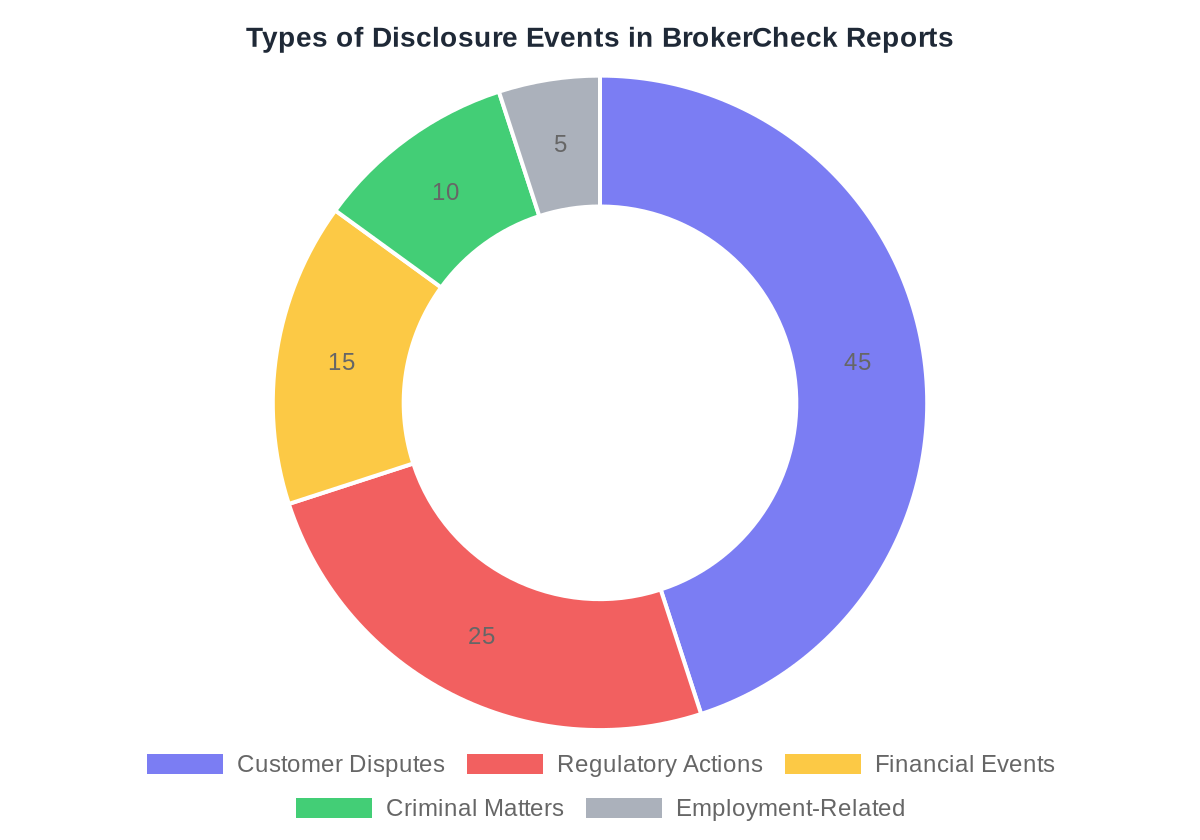
This is the section that matters most. Disclosures cover:
- Customer disputes — complaints filed by clients, arbitration outcomes, and any settlement amounts
- Regulatory actions — fines, suspensions, or bars from the industry issued by FINRA, the SEC, or state regulators
- Criminal matters — charges and convictions related to financial crimes or dishonesty
- Financial events — bankruptcies, unpaid judgements, and liens
Each disclosure comes with a description and outcome. One old complaint, settled in the broker's favour, may mean nothing. A pattern of complaints, recurring regulatory sanctions, or a criminal charge is a different matter entirely.
Red Flags Worth Taking Seriously
Not every disclosure is alarming. Brokers can — and do — respond to their own disclosures with explanations. But some patterns consistently signal a problem.
Multiple customer disputes. A single complaint can be a disgruntled client. Three or more, especially involving similar allegations, suggests a pattern. Check whether the disputes were resolved in the client's favour and for how much.
Regulatory sanctions. Fines from FINRA or the SEC are not minor paperwork errors. They mean a regulator found a rule violation serious enough to penalise. Read what the sanction was for — excessive trading (churning), unsuitable recommendations, and failure to supervise are common categories.
Frequent firm changes. Some brokers move firms often. That can be fine. But terminations "for cause" — where the firm fired them following an allegation of misconduct — are flagged separately in BrokerCheck and deserve a direct question.
Employment gaps. A year or two without any firm registration might mean the broker left the industry temporarily. It might also follow a suspension they'd rather not explain.
One thing BrokerCheck doesn't flag: clone firms. Scammers sometimes use a legitimate broker's real CRD number in marketing materials while operating a completely separate, unregistered entity. If you find the broker in BrokerCheck, cross-check that the website address and contact details match what's on file.
BrokerCheck vs. IAPD vs. NFA BASIC vs. SEC EDGAR
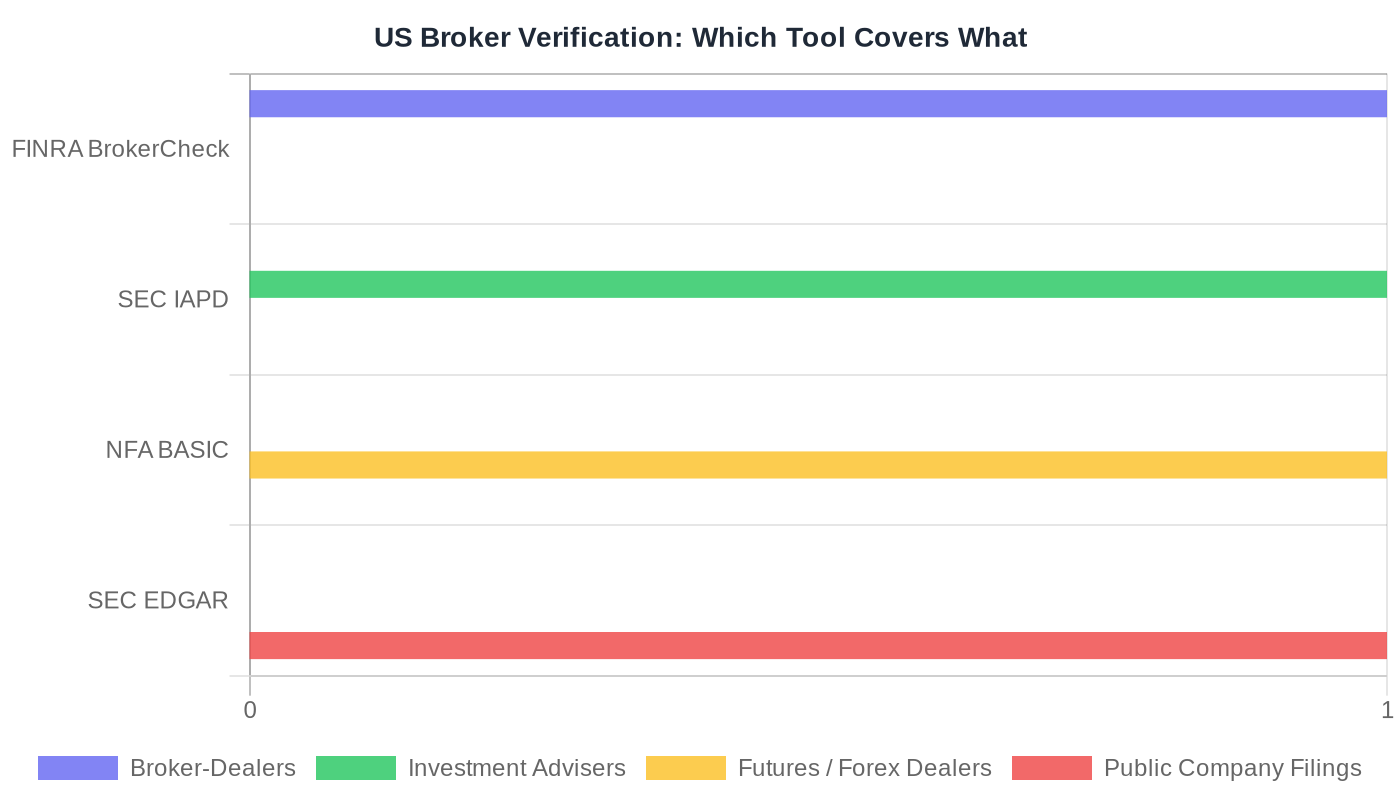
BrokerCheck covers broker-dealers — firms and individuals who buy and sell securities. If you're dealing with someone in a different capacity, you may need a different tool.
| Tool | Who It Covers | What It Shows | URL |
|---|---|---|---|
| FINRA BrokerCheck | Broker-dealers and registered representatives | Registration, employment history, qualifications, disclosures | brokercheck.finra.org |
| SEC IAPD | Registered investment advisers (RIAs) | Form ADV filings, advisory services, fee structure, disciplinary history | adviserinfo.sec.gov |
| NFA BASIC | Futures brokers, CPOs, CTAs, and forex dealers | NFA registration, disciplinary actions, arbitration awards | nfa.futures.org/basicnet |
| SEC EDGAR | Public companies and fund managers | SEC filings, registration statements, enforcement releases | sec.gov/cgi-bin/browse-edgar |
For forex traders specifically, this matters. A broker offering forex trading in the US may register with FINRA (if they're a broker-dealer), with the NFA (if they hold a Retail Foreign Exchange Dealer licence), or both. Always check the NFA's BASIC database alongside BrokerCheck for any forex firm claiming US regulation. If a firm claims to be "CFTC-regulated" but doesn't appear on NFA BASIC, they aren't.
What BrokerCheck Doesn't Show
BrokerCheck is thorough for what it covers. It's not exhaustive.
Records older than 10 years. Brokers who left the industry more than a decade ago may no longer appear unless they had a serious disclosure event. Those disclosures — regulatory bars, certain criminal matters — are permanent.
Expunged disclosures. Brokers can petition to have complaints removed from their record through a legal process called expungement. When successful, the disclosure disappears. A clean report doesn't always mean there were never any complaints.
Non-FINRA professionals. Insurance agents, financial planners who are not also registered investment advisers, and mortgage brokers don't appear in BrokerCheck at all. Each profession has its own registry.
Investment performance. BrokerCheck tells you about registration and compliance history. It doesn't evaluate whether a broker is good at their job.
None of this makes BrokerCheck less useful. It just means it's one check — not the only one.
The Bottom Line on FINRA BrokerCheck
FINRA BrokerCheck takes two minutes and costs nothing. For any US-registered broker or brokerage firm, it shows you what a regulator's file actually contains — employment history, qualifications, and any disclosures that made it through the reporting system. For forex and securities traders evaluating US brokers, this is the first lookup to run before anything else. For a complete picture, pair it with NFA BASIC (for forex/futures), the SEC's IAPD (for investment advisers), and a direct verification of the firm's registered entity against what appears on their website.
Frequently Asked Questions
Is FINRA BrokerCheck free?
Yes. BrokerCheck is completely free to use and requires no registration. Any search you run is also anonymous — the broker or firm you look up is not notified.
What is a CRD number?
CRD stands for Central Registration Depository. It's the unique identification number assigned to every broker and brokerage firm registered with FINRA. You can search BrokerCheck by name or CRD number — using the CRD number avoids ambiguity if a broker has a common name. Reputable US brokers list their CRD number on their website.
How do I verify if a broker is legitimate using BrokerCheck?
Go to brokercheck.finra.org, enter the broker's name or CRD number, and check their registration status. An active registration means they are currently authorised to operate. Also review the disclosures section for any customer disputes, regulatory sanctions, or criminal matters. A broker with an active registration and a clean disclosure record is a good starting point.
Can I trust a clean BrokerCheck report?
It's a strong signal, not a guarantee. Clean reports can reflect an absence of complaints, or complaints that were expunged. Some issues — like unsuitable advice that never escalated to a formal dispute — won't appear at all. Treat a clean report as a necessary baseline check, not a final verdict.
What is the difference between BrokerCheck and the SEC IAPD?
BrokerCheck covers broker-dealers — firms and individuals who execute securities transactions. The SEC's Investment Adviser Public Disclosure (IAPD) database covers registered investment advisers, who provide fee-based financial planning and portfolio management advice. Some professionals are registered in both databases. If you're working with an adviser rather than a broker, start with the IAPD.
Does BrokerCheck cover forex brokers?
It depends on the broker's registration. US forex brokers who hold a broker-dealer registration will appear in BrokerCheck. Those operating as Retail Foreign Exchange Dealers under CFTC oversight are registered with the NFA, and their records appear in the NFA BASIC database at nfa.futures.org/basicnet — not in BrokerCheck. Check both databases when vetting any US forex firm.
What should I do if I find a serious disclosure on BrokerCheck?
Read the full disclosure and the broker's response. One older complaint, resolved in the broker's favour, may not change your decision. Regulatory sanctions, criminal matters, or multiple unresolved customer disputes are worth taking seriously. You can file a complaint with FINRA at finra.org/investors if you believe you've experienced misconduct.
Last verified: April 2026. FINRA firm statistics sourced from FINRA 2024 Industry Snapshot.