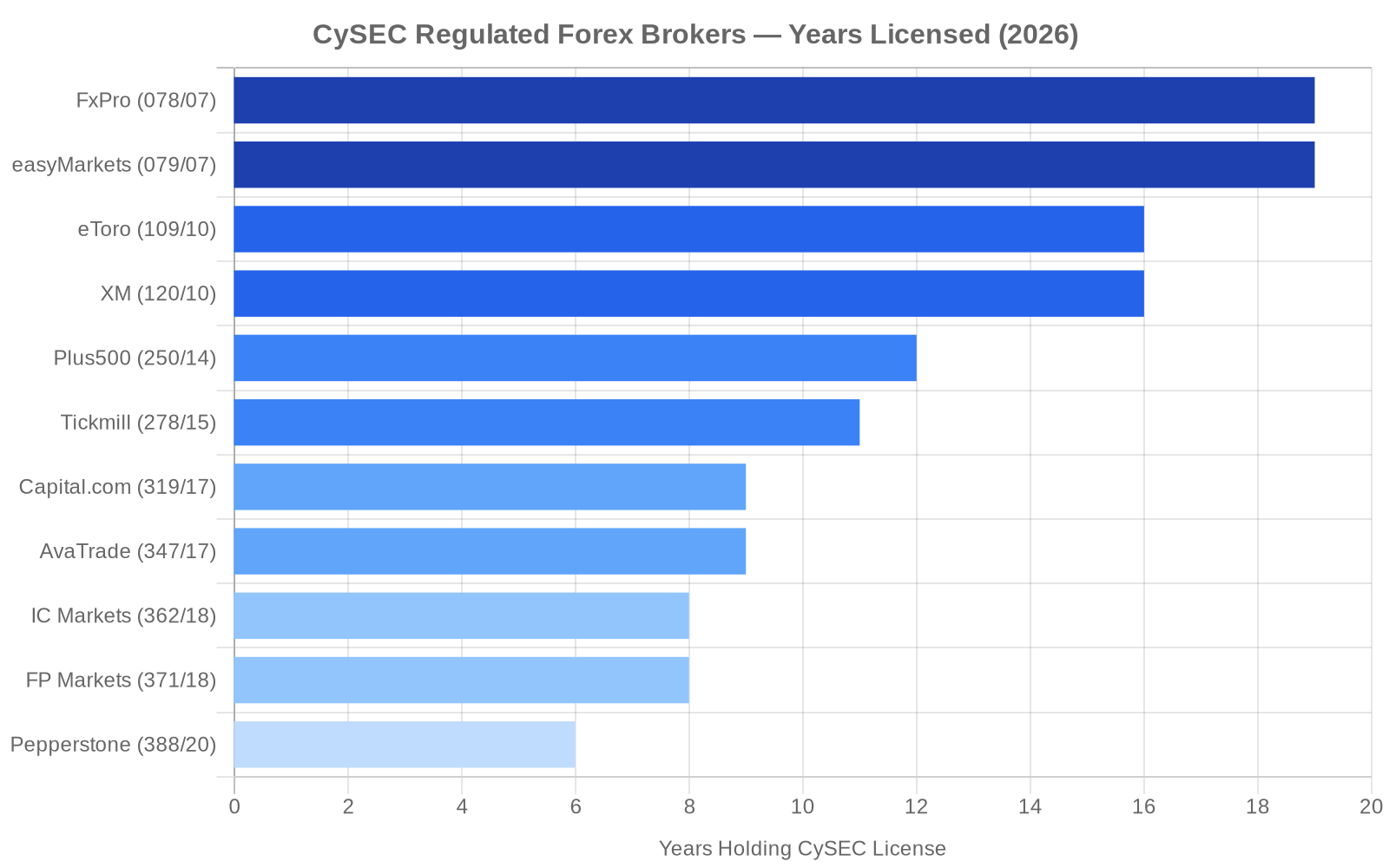
The Cyprus Securities and Exchange Commission (CySEC) supervises over 300 Cyprus Investment Firms, making it the single largest forex broker regulator in the European Union (CySEC, 2026). A CySEC license grants MiFID II passporting rights across all 27 EU member states — which is why the majority of internationally recognised forex brokers maintain a Cyprus-incorporated entity. CySEC-regulated brokers must participate in the Investor Compensation Fund (ICF), covering retail clients up to €20,000 per person if the firm becomes insolvent (CySEC ICF, 2026).
We searched the CySEC public registry and verified the license status of every broker listed below. Each entry links directly to its registry record so you can confirm for yourself.
Last verified: 14 March 2026 | Brokers checked: 15 | Source: CySEC Public Register
TL;DR: All 15 brokers below hold verified, active CySEC authorisation. EU retail clients get ICF protection up to €20,000, mandatory negative balance protection, and maximum leverage of 1:30 on major forex pairs under ESMA rules. CySEC licenses passport across all EU countries via MiFID II — but always confirm you're trading under the Cyprus entity, not an offshore subsidiary.
What Is CySEC and Why Does It Matter for Forex Traders?
CySEC was established in 2001 as an independent public supervisory authority under the Cyprus Securities and Exchange Commission (Establishment and Responsibilities) Law of 2001 (CySEC, 2026). Its jurisdiction covers the Republic of Cyprus, but its real significance for forex traders extends across the entire European Union.
Here's the thing most people miss about CySEC. Cyprus joined the EU in 2004, which meant CySEC-licensed firms gained automatic passporting rights under MiFID (later MiFID II). A broker with CySEC license number 120/10 can legally serve clients in Germany, France, Spain, and every other EU member state without obtaining separate licenses in each country. That's why Cyprus became the European hub for forex brokers — not because regulation is weak (a common misconception), but because one license covers 27 countries.
"CySEC is committed to the effective supervision and development of the capital market of the Republic of Cyprus, with the protection of investors being its primary goal," states the regulator on its official mandate page (CySEC, 2026).
CySEC applied €2.76 million in administrative penalties during 2024 alone, demonstrating active enforcement rather than rubber-stamp oversight. The regulator also implemented new sanctions compliance rules effective August 2025, with penalties for non-compliant firms reaching up to 5% of global turnover or €40 million — whichever is higher (Finance Magnates, 2025).
| Detail | Value |
|---|---|
| Full Name | Cyprus Securities and Exchange Commission |
| Abbreviation | CySEC |
| Jurisdiction | Republic of Cyprus (EU Member State) |
| Established | 2001 |
| Supervised Investment Firms | 300+ Cyprus Investment Firms (CIFs) |
| Minimum Capital Requirement | €75,000 – €750,000 (varies by license type) |
| Compensation Scheme | Investor Compensation Fund (ICF), up to €20,000 |
| Segregated Funds Required | Yes |
| Negative Balance Protection | Yes (retail clients, ESMA rules) |
| Max Retail Leverage | 1:30 (forex majors, ESMA harmonised) |
| Public Registry URL | CySEC Regulated Entities |
| Warning List URL | CySEC Announcements |
Verified CySEC Broker Database
We checked each broker below against the CySEC public register. The table shows what we found — license status, entity name on the license (often different from the trading brand), and a direct link to verify each entry yourself.
This is not a ranking. Brokers are sorted by license status (active first), then by license date (longest-held first). No broker paid for inclusion.
| Broker | License # | Entity Name | Status | Since | ICF | Warnings | Verify |
|---|---|---|---|---|---|---|---|
| FxPro | 078/07 | FxPro Financial Services Ltd | ✅ Active | 2007 | €20K | None | Registry → |
| easyMarkets | 079/07 | Easy Forex Trading Ltd | ✅ Active | 2007 | €20K | None | Registry → |
| Markets.com | 092/08 | Safecap Investments Ltd | ✅ Active | 2008 | €20K | None | Registry → |
| eToro | 109/10 | eToro (Europe) Ltd | ✅ Active | 2010 | €20K | None | Registry → |
| XM | 120/10 | Trading Point of Financial Instruments Ltd | ✅ Active | 2010 | €20K | None | Registry → |
| Libertex | 164/12 | Indication Investments Ltd | ✅ Active | 2012 | €20K | None | Registry → |
| XTB | 169/12 | XTB Limited | ✅ Active | 2012 | €20K | None | Registry → |
| Admirals | 201/13 | Admiral Markets Cyprus Ltd | ✅ Active | 2013 | €20K | None | Registry → |
| Plus500 | 250/14 | Plus500CY Ltd | ✅ Active | 2014 | €20K | None | Registry → |
| Tickmill | 278/15 | Tickmill Europe Ltd | ✅ Active | 2015 | €20K | None | Registry → |
| Capital.com | 319/17 | Capital Com SV Investments Ltd | ✅ Active | 2017 | €20K | None | Registry → |
| AvaTrade | 347/17 | DT Direct Investment Hub Ltd | ✅ Active | 2017 | €20K | None | Registry → |
| IC Markets | 362/18 | IC Markets (EU) Ltd | ✅ Active | 2018 | €20K | ⚠️ €50K fine (2024) | Registry → |
| FP Markets | 371/18 | FP Markets (EU) Ltd | ✅ Active | 2018 | €20K | None | Registry → |
| Pepperstone | 388/20 | Pepperstone EU Ltd | ✅ Active | 2020 | €20K | None | Registry → |
All license numbers verified against the CySEC public register as of March 2026. Registry links point directly to each firm's official entry.
FxPro — CySEC License 078/07
License: CySEC 078/07 | Entity: FxPro Financial Services Ltd | Since: 2007 Verify on CySEC Register →
FxPro has held its CySEC license since 2007 — one of the earliest forex brokers to obtain Cyprus regulation. The firm also holds licenses from the FCA (UK), FSCA (South Africa), and SCB (Bahamas), creating a multi-jurisdictional supervision structure that few brokers match.
We checked the CySEC register and found the license active with no restrictions or conditions. FxPro Financial Services Ltd is authorised for reception and transmission of orders, execution of orders on behalf of clients, dealing on own account, and portfolio management. The scope of authorisation matters — it means FxPro can legally hold client funds and execute trades as principal.
The company has processed over 400 million orders since founding, according to its public disclosures. No CySEC enforcement actions, warnings, or fines appear against this entity in the regulator's decision archive.
Key finding: One of the longest-standing CySEC licenses in the forex industry — 19 years of continuous authorisation with a clean enforcement record. Full safety investigation: Is FxPro Safe? (Coming soon)
XM — CySEC License 120/10
License: CySEC 120/10 | Entity: Trading Point of Financial Instruments Ltd | Since: 2010 Verify on CySEC Register →
XM operates its European entity through Trading Point of Financial Instruments Ltd — a name most traders won't recognise because the brand name and legal entity name are completely different. This disconnect between brand and license is exactly what makes registry verification important.
The CySEC license has been active since 2010. XM also holds licenses from ASIC (Australia), DFSA (Dubai), and the IFSC (Belize). EU retail clients should be trading under the CySEC entity specifically — the Belize entity has considerably weaker protections.
XM reports over 15 million registered clients globally and operates in over 190 countries. No enforcement actions recorded against Trading Point of Financial Instruments Ltd on the CySEC decision register.
Key finding: Trading under the brand name "XM" but the CySEC-licensed entity is "Trading Point of Financial Instruments Ltd" — always confirm which entity your account is registered under. Full safety investigation: Is XM Safe? (Coming soon)
eToro — CySEC License 109/10
License: CySEC 109/10 | Entity: eToro (Europe) Ltd | Since: 2010 Verify on CySEC Register →
eToro holds CySEC, FCA, and ASIC licenses simultaneously. The European entity — eToro (Europe) Ltd — operates from Cyprus and serves EU clients under MiFID II passporting. With over 30 million registered users globally, eToro is one of the largest retail trading platforms by user count.
The CySEC license has been active since 2010 with no restrictions noted. eToro's social trading and copy trading features are regulated activities under the CySEC license, which means the platform itself falls under regulatory oversight — not just the trade execution.
One thing to watch: eToro also operates eToro (UK) Ltd under FCA regulation and eToro AUS Capital Ltd under ASIC. Your regulatory protection depends entirely on which entity you sign up with. EU residents will typically be onboarded to the CySEC entity, but check your account agreement to confirm.
Key finding: CySEC license covers both trading and social/copy trading activities — regulatory oversight extends to the platform features, not just order execution. Full safety investigation: Is eToro Safe? (Coming soon)
IC Markets — CySEC License 362/18
License: CySEC 362/18 | Entity: IC Markets (EU) Ltd | Since: 2018 Verify on CySEC Register →
IC Markets obtained its CySEC license in 2018 to serve EU clients specifically. The primary entity — International Capital Markets Pty Ltd — is regulated by ASIC in Australia. This dual-license structure means IC Markets can serve both Australian and European clients under their respective Tier 1 regulatory frameworks.
However, IC Markets (EU) Ltd received a €50,000 administrative fine from CySEC in July 2024. The fine included €30,000 for not taking "all sufficient steps to obtain the best possible result for clients" when executing orders — a best execution violation (FX News Group, 2024). An additional €20,000 was levied for related compliance shortcomings.
The license remains active with no restrictions despite the fine. Some traders see enforcement action as a negative. Another reading: the regulator is actively supervising and holding firms accountable. An unregulated broker wouldn't face any consequences for the same behaviour.
Key finding: Active CySEC license with one recorded enforcement action — a €50,000 fine for best execution failures in 2024. License remains unrestricted. Full safety investigation: Is IC Markets Safe? (Coming soon)
Pepperstone — CySEC License 388/20
License: CySEC 388/20 | Entity: Pepperstone EU Ltd | Since: 2020 Verify on CySEC Register →
Pepperstone launched its CySEC-regulated entity in 2020 to serve the European market directly. The firm was already established in Australia (ASIC) and the UK (FCA), with the Cyprus entity adding EU passporting to its regulatory coverage.
The CySEC license is relatively recent compared to brokers like FxPro (2007) or XM (2010), but Pepperstone's track record under other Tier 1 regulators provides context. No enforcement actions recorded against Pepperstone EU Ltd on the CySEC register.
The CySEC license authorises Pepperstone EU Ltd for the full range of investment services — reception and transmission of orders, execution of orders on behalf of clients, and portfolio management. The firm's EU compliance structure operates independently from its Australian and UK entities, with a dedicated compliance team in Limassol.
Key finding: Clean CySEC record since 2020. Newer Cyprus entity but backed by established ASIC and FCA licenses — provides EU passporting to complement the firm's existing regulatory footprint. Full safety investigation: Is Pepperstone Safe? (Coming soon)
Plus500 — CySEC License 250/14
License: CySEC 250/14 | Entity: Plus500CY Ltd | Since: 2014 Verify on CySEC Register →
Plus500 is publicly listed on the London Stock Exchange (LON: PLUS), which adds an additional layer of financial reporting transparency on top of CySEC requirements. The firm reports quarterly financials and undergoes external audits as part of its listing obligations.
The CySEC license has been active since 2014 with no enforcement actions or restrictions on record. Plus500CY Ltd serves EU clients while Plus500UK Ltd handles UK clients under FCA regulation. Over 24 million registered customers globally as of 2024.
The platform intentionally limits itself to CFD trading — no MetaTrader integration, no algorithmic trading, no social features. For regulatory purposes, this simplicity means fewer complex product types for CySEC to supervise.
Key finding: Publicly listed company with dual CySEC/FCA licenses and clean enforcement history. Financial transparency exceeds typical CIF requirements due to LSE listing obligations. Full safety investigation: Is Plus500 Safe? (Coming soon)
How to Verify a Broker's CySEC License Yourself
You don't need to trust our table — or anyone else's list. CySEC maintains a free, searchable public register. Here's how to use it.
Step 1: Go to the CySEC Public Register
Visit cysec.gov.cy/en-GB/entities/investment-firms/cypriot/. This is the only authoritative source. Third-party broker review sites can be outdated, paid, or wrong.
Step 2: Search by Company Name or License Number
Enter the broker's legal entity name or their CySEC license number (format: XXX/YY, e.g., 120/10). Important: search the legal entity name, not the trading brand. "XM" won't return results — you need "Trading Point of Financial Instruments Ltd." Most brokers display their license number in their website footer. Use that number for a direct match.
Step 3: Check the Authorization Status
The registry entry shows the firm's current status. You're looking for "Active" or "Authorised." If the status shows "Suspended," "Under resolution," or "Revoked," stop immediately. Also check for any conditions or restrictions listed — some firms have licenses limited to specific services.
Step 4: Verify the Permitted Services
Click into the firm's detailed registry entry. CySEC licenses cover specific "Investment Services and Activities" — for forex trading, the firm should be authorised for "Reception and Transmission of Orders" and "Execution of Orders on Behalf of Clients" at minimum. Some firms are authorised for "Dealing on Own Account" as well, meaning they can act as the counterparty to your trades (market making).
Step 5: Cross-Check the Warning List
Visit the CySEC Announcements page and search for the broker name. CySEC publishes warnings about unauthorised firms, clone companies, and fraudulent websites here. In March 2025 alone, CySEC flagged 21 fraudulent websites — including clones of AvaTrade and OneRoyal (Finance Magnates, 2025).
Step 6: Confirm the Website Matches the Registry
Compare the registered website URL and address on the CySEC entry against the website you're actually visiting. Clone firm scammers copy real license numbers and paste them on fake websites. If the URL on CySEC's register doesn't match the website soliciting your deposit, you're looking at a scam.
What CySEC Protection Actually Means for Your Money
CySEC regulation under MiFID II gives EU retail forex traders a specific set of protections. Not promises — legally binding requirements.
Investor Compensation Fund (ICF)
Every CySEC-licensed investment firm must participate in the ICF. If your broker becomes insolvent and cannot return your funds, the ICF covers up to €20,000 per eligible client — defined as the lower of 90% of your cumulative covered claims and €20,000 (CySEC ICF, 2026).
That's significantly less than the FCA's £85,000 FSCS coverage — roughly 23% of the UK limit at current exchange rates. For context: if your CySEC broker held €50,000 of your funds and went bankrupt, you'd recover €20,000 from the ICF. The remaining €30,000 would depend on the insolvency proceedings. The ICF is funded by annual contributions from all CySEC-licensed investment firms, with the total fund size exceeding €100 million across all member contributions (RSM Cyprus, 2025).
The ICF claim process works like this: CySEC determines a member firm cannot meet its obligations, the ICF publishes an invitation to claim in national newspapers and on the CySEC website, and you submit an application within 5-9 months. Claims are evaluated by a qualified accountant and an advocate, with the ICF Administrative Committee making the final decision (CySEC ICF Guide, 2026).
Leverage Limits (ESMA Harmonised)
CySEC follows the same ESMA leverage limits as all EU regulators:
| Asset Class | Max Retail Leverage | Max Professional Leverage |
|---|---|---|
| Forex Majors (EUR/USD, GBP/USD) | 1:30 | Up to 1:500 |
| Forex Minors and Gold | 1:20 | Up to 1:500 |
| Major Indices | 1:20 | Varies |
| Other Commodities | 1:10 | Varies |
| Individual Equities | 1:5 | Varies |
| Cryptocurrency CFDs | 1:2 | Varies |
These are identical to FCA limits — not because CySEC copies the FCA, but because both implement the same ESMA intervention measures. Before 2018, CySEC-licensed brokers could offer retail leverage up to 1:500 or higher.
Segregated Client Funds
CySEC-regulated brokers must hold client funds in segregated accounts separate from the firm's operating capital. If the broker faces financial difficulty, your trading capital is ringfenced from company creditors. The funds must be held in credit institutions within the EU.
Negative Balance Protection
Retail clients cannot lose more than their deposited funds. If a flash crash drives your account below zero, the broker absorbs the negative balance. This rule prevented significant retail losses during events like the 2015 Swiss franc crisis and various flash crashes in volatile currency pairs.
Red Flags: When "CySEC-Regulated" Doesn't Mean What You Think
Having a CySEC license doesn't automatically make a broker safe. And some entities claiming CySEC regulation don't have it at all.
Clone Firms — The Most Dangerous Scam
Clone firms copy the real CySEC license numbers of legitimate brokers and paste them on fraudulent websites. CySEC's warning list now includes over 200 unauthorised entities flagged since 2020. In one documented case, a platform called "Mic-Market" cloned Colmex's CySEC license, replicating both the license number and website design. New Zealand's FMA caught it and issued a public warning (Finance Magnates, 2025).
How to spot a clone: search the license number on CySEC's register, then compare the registered company name, website URL, and physical address against what the broker showed you. If any detail doesn't match, walk away.
Offshore Entity Routing
A broker group might hold a CySEC license through one entity but route you to a different entity registered in Vanuatu, the Seychelles, or Saint Vincent and the Grenadines. The signup flow subtly switches you to the offshore entity — sometimes through a different URL, sometimes through a clause in the terms and conditions.
Check your account opening documents. The entity name on your client agreement must match the CySEC-registered entity. If it says "XYZ (SVG) Ltd" instead of "XYZ (EU) Ltd," you're not under CySEC protection.
MiFID II Passporting — Limitations to Understand
CySEC-licensed brokers can "passport" their services across the EU, meaning they can serve clients in Germany, France, Italy, and all other member states without a local license. The regulator of record remains CySEC. This works well in practice, but there's a wrinkle: if you file a complaint, you're dealing with CySEC in Nicosia, Cyprus — not your local financial regulator. Language barriers and time zones can complicate the process.
Some EU countries — notably Germany (BaFin) and France (AMF) — have pushed for stricter oversight of passported firms. If a CySEC-licensed broker causes harm in Germany, BaFin can restrict the firm's local activities but cannot revoke the CySEC license. Cross-border enforcement is improving but still imperfect.
Fake CySEC Impersonation
CySEC itself has been impersonated — a tactic targeting an estimated 4,000+ fraud victims across Europe annually. Scammers posing as CySEC officers contact victims — usually people who lost money trading with unregulated brokers — offering to help "recover" lost funds. They demand fees for this fake recovery service. CySEC issued a public warning in March 2025 about this tactic, noting that fraudsters use official-looking logos, stamps, and forged signatures (CySEC Warning, 2025).
CySEC will never contact you asking for payment. If someone claims to represent CySEC and asks for money, it's a scam. Report it directly through the official CySEC website.
"CySEC Registered" vs "CySEC Authorised"
Not all entries on CySEC's list carry the same weight. Investment firms (CIFs) hold full CySEC authorization with capital requirements and ICF participation. But CySEC also lists firms that are registered or tied agents — these entities have different oversight levels. For forex trading, you want a fully authorised Cyprus Investment Firm, not a registered entity or tied agent.
Recent CySEC Enforcement Actions Against Forex Brokers
CySEC maintains an active enforcement posture. The regulator applied €2.76 million in administrative penalties during 2024. Here are notable recent actions against forex and CFD firms.
| Date | Broker/Entity | Action | Reason | Fine/Penalty |
|---|---|---|---|---|
| July 2024 | IC Markets (EU) Ltd | Administrative fine | Best execution failures + compliance shortcomings | €50,000 |
| July 2025 | Conotoxia Ltd | Administrative fine | Non-compliance with AML/CTF directive | [Amount not public] |
| Sep 2025 | Lydya Financial Ltd | Administrative fine | Missing RBSF-CIF return deadline (2024) | €850 |
| Jul 2025 | Lydya Financial Ltd | Administrative fine | Missing quarterly QST-CIF report (Q1) | €100 |
| 2025 | Toxotis Investments | License suspension | Failure to submit annual reports (2023 + 2024) | Suspended until compliance |
| Aug 2025 | [Multiple firms] | Regulatory circular | New EU sanctions compliance regime | Up to 5% of global turnover |
Sources: CySEC Board Decisions, FX News Group, Finance Magnates
The pattern is clear: CySEC isn't a rubber stamp. The IC Markets fine for best execution failures signals that the regulator scrutinises how brokers handle orders — not just whether they hold enough capital. The sanctions regime update (August 2025) dramatically increased the maximum penalty from relatively modest fixed amounts to 5% of global turnover, aligning CySEC with ESMA's enforcement expectations.
CySEC vs FCA vs ASIC — How Does Cyprus Regulation Compare?
Traders often ask whether CySEC is "as good" as the FCA or ASIC. The honest answer: it depends on what you care about.
| Protection | CySEC (EU/Cyprus) | FCA (UK) | ASIC (Australia) |
|---|---|---|---|
| Compensation scheme | ICF: €20,000 | FSCS: £85,000 | None for forex |
| Negative balance protection | Mandatory (retail) | Mandatory (retail) | Mandatory (retail) |
| Segregated client funds | Required | Required | Required |
| Max retail leverage (forex) | 1:30 | 1:30 | 1:30 |
| Risk warning requirement | Yes (% losing accounts) | Yes (% losing accounts) | Yes |
| EU passporting | All 27 EU states | N/A (post-Brexit) | N/A |
| Regulatory tier | Tier 1 (EU harmonised) | Tier 1 | Tier 1 |
The biggest gap is the compensation scheme. If your broker goes bankrupt, FCA-regulated clients could recover up to £85,000 — more than four times CySEC's €20,000 ICF limit. ASIC offers no equivalent compensation fund for forex traders at all.
CySEC's advantage is geographical coverage. A single CySEC license serves all 27 EU countries — a combined population of approximately 450 million people — through MiFID II passporting. Post-Brexit, FCA licenses no longer provide EU market access — which is exactly why brokers like Pepperstone, IC Markets, and FP Markets established separate CySEC entities starting in 2018-2020. Over 40 internationally recognised forex brokers now maintain CySEC-licensed EU entities (BestBrokers, 2026).
For regulatory stringency on day-to-day operations — leverage caps, negative balance protection, segregated funds, risk disclosures — CySEC, FCA, and ASIC are essentially equivalent. All three implement the same fundamental protections. The difference is in the safety net when things go wrong.
The Bottom Line on CySEC Regulated Forex Brokers
CySEC regulation provides solid, EU-harmonised protection for retail forex traders — mandatory fund segregation, negative balance protection, leverage caps, and the ICF safety net up to €20,000. It's not the highest compensation limit among Tier 1 regulators (the FCA's £85,000 is four times higher), but CySEC's MiFID II passporting makes it the most geographically versatile forex license in Europe. Every broker on this page holds a verified, active CySEC license — but don't take our word for it. Use the CySEC public register to verify any broker's status yourself before depositing funds. For how CySEC stacks up against UK regulation specifically, see our FCA regulated forex brokers guide.
Frequently Asked Questions
Is CySEC a Tier 1 regulator?
CySEC is classified as a Tier 1 regulator by most industry standards. As an EU member state regulator operating under MiFID II, CySEC enforces the same investor protection rules as all other European financial authorities. The regulator applied €2.76 million in penalties during 2024 and implemented enhanced sanctions compliance rules in 2025 with fines up to €40 million or 5% of global turnover.
How do I check if a forex broker is CySEC regulated?
Visit the CySEC public register and search by company name or license number (format: XXX/YY). Verify the entity name matches your account documents — the legal name on the license often differs from the broker's trading brand. Cross-reference the registered website URL against the site you're actually visiting.
What happens if my CySEC-regulated broker goes bankrupt?
The Investor Compensation Fund (ICF) covers eligible retail clients up to €20,000 per person — calculated as the lower of 90% of your covered claims and €20,000. CySEC determines when a firm cannot meet its obligations, the ICF publishes a claim invitation, and you submit an application within the published deadline. Claims are evaluated by an accountant and advocate before the ICF Administrative Committee decides.
What is the maximum compensation from CySEC's Investor Compensation Fund?
The ICF maximum is €20,000 per eligible client. This is significantly lower than the FCA's FSCS (£85,000) but higher than ASIC, which has no equivalent compensation scheme for forex traders. The €20,000 cap covers retail clients only — professional clients and certain institutional investors are excluded.
Can I trade with a CySEC broker from outside the EU?
CySEC licenses are designed for the EU market. Whether a CySEC-regulated broker accepts clients from your country depends on the broker's own onboarding policy and your country's regulatory requirements. Many international brokers operate separate entities for different regions — a CySEC entity for EU clients, an FCA entity for UK clients, and an offshore entity for the rest of the world.
Why do so many forex brokers choose CySEC?
MiFID II passporting. A single CySEC license gives a broker legal access to serve clients across all 27 EU member states without obtaining separate licenses in each country. Combined with Cyprus's favourable corporate tax rate (12.5%) and established financial services infrastructure, this makes CySEC the most practical regulatory choice for brokers targeting the European market.
Are all CySEC-regulated brokers safe?
No. A CySEC license sets a minimum standard — capital requirements, fund segregation, conduct rules — but it doesn't guarantee competent management, fair pricing, or financial stability. IC Markets (EU) Ltd received a €50,000 CySEC fine in 2024 for best execution failures. CySEC has also suspended licenses (Toxotis Investments, 2025) and flagged dozens of clone firms impersonating legitimate CySEC-licensed brokers.
What is a clone firm and how do I avoid CySEC-related clone scams?
Clone firms copy real CySEC license numbers from legitimate brokers and display them on fraudulent websites. CySEC flagged 21 fraudulent websites in March 2025 alone, including clones of AvaTrade and OneRoyal. To avoid clones: search the license number on CySEC's official register, compare the registered company name and website URL against what the broker showed you, and never deposit funds if any detail doesn't match.
Does CySEC regulate cryptocurrency trading?
CySEC regulates cryptocurrency CFDs — contracts for difference on crypto assets — under the same ESMA framework that governs forex CFDs. Retail leverage on crypto CFDs is capped at 1:2. However, CySEC does not regulate spot cryptocurrency exchanges or decentralised finance (DeFi) platforms. If a broker offers crypto CFDs alongside forex under a CySEC license, both are regulated. If they offer spot crypto separately, that activity may fall outside CySEC's oversight.
How long does a CySEC complaint take to resolve?
CySEC does not handle individual investor complaints directly in most cases — that responsibility falls on the broker's internal complaints procedure first. If you're unsatisfied with the broker's response, you can file a complaint with CySEC, which will review whether the firm breached its regulatory obligations. The Financial Ombudsman Service of the Republic of Cyprus handles consumer disputes. Resolution timelines vary, but expect 3-6 months for a formal investigation.
What is the difference between CySEC and ESMA?
CySEC is the national financial regulator of Cyprus. ESMA (European Securities and Markets Authority) is the EU-level supervisory body that sets harmonised rules for all EU member state regulators — including CySEC. ESMA established the leverage limits, negative balance protection, and risk warning requirements that CySEC enforces. Think of ESMA as the rule-maker and CySEC as the enforcer for Cyprus-licensed firms.
Related Resources
- FCA Regulated Forex Brokers — Verified List (2026) — UK regulation with £85,000 FSCS protection
- UK Regulated Brokers — How UK broker regulation works in practice
- Regulation Overview — All regulator guides and broker verification resources