IC Markets is one of the most competitive ECN brokers available to retail traders today. Raw account spreads average 0.1 pips on EUR/USD with a $3.50 commission per lot per side. Execution averages 40ms. You get four platforms — MT4, MT5, cTrader, and TradingView — plus over 3,500 instruments across forex, indices, commodities, shares, and crypto. ASIC and CySEC regulation covers the main entities. Minimum deposit sits at $200. It earns a 4.3/5 from me, losing points mainly on education and research depth.
IC Markets: Pros and Cons
Pros:
- Raw spreads from 0.0 pips (EUR/USD average 0.1 pips on Raw accounts)
- Four full platforms: MT4, MT5, cTrader, TradingView
- Regulated by ASIC, CySEC, FSA, SCB, and FSCA
- 3,500+ instruments — forex, indices, shares, commodities, crypto
- Zero fees on all deposits and withdrawals
- 40ms average order execution speed
- 24/7 live chat support in 8+ languages
- Free VPS hosting for algorithmic traders
- Social trading via ZuluTrade and Myfxbook
Cons:
- Education section is thin — not a beginner's first choice
- $200 minimum deposit (higher than some no-frills competitors)
- Limited research tools versus top-tier brokers like IG
- Some withdrawal methods take 3–5 business days
- cTrader is only available on True ECN accounts
IC Markets: General Overview
International Capital Markets, known universally as IC Markets, has been operating out of Sydney since 2007. It's an ECN broker — orders route through to the interbank market rather than sitting with a dealing desk. For scalpers and high-frequency traders, that distinction matters quite a bit.
The broker has expanded significantly since those early days. What started as a forex-focused service now covers over 3,500 instruments and four distinct trading platforms. The client base spans over 200 countries. I've tracked this broker closely over the past few years, and the growth hasn't come at the cost of execution quality — which is the main thing to watch for when brokers scale up fast.
Overall Rating: 4.3/5 — based on spreads, execution quality, regulation, and platform depth.
Is IC Markets Safe? Regulation and Client Protection
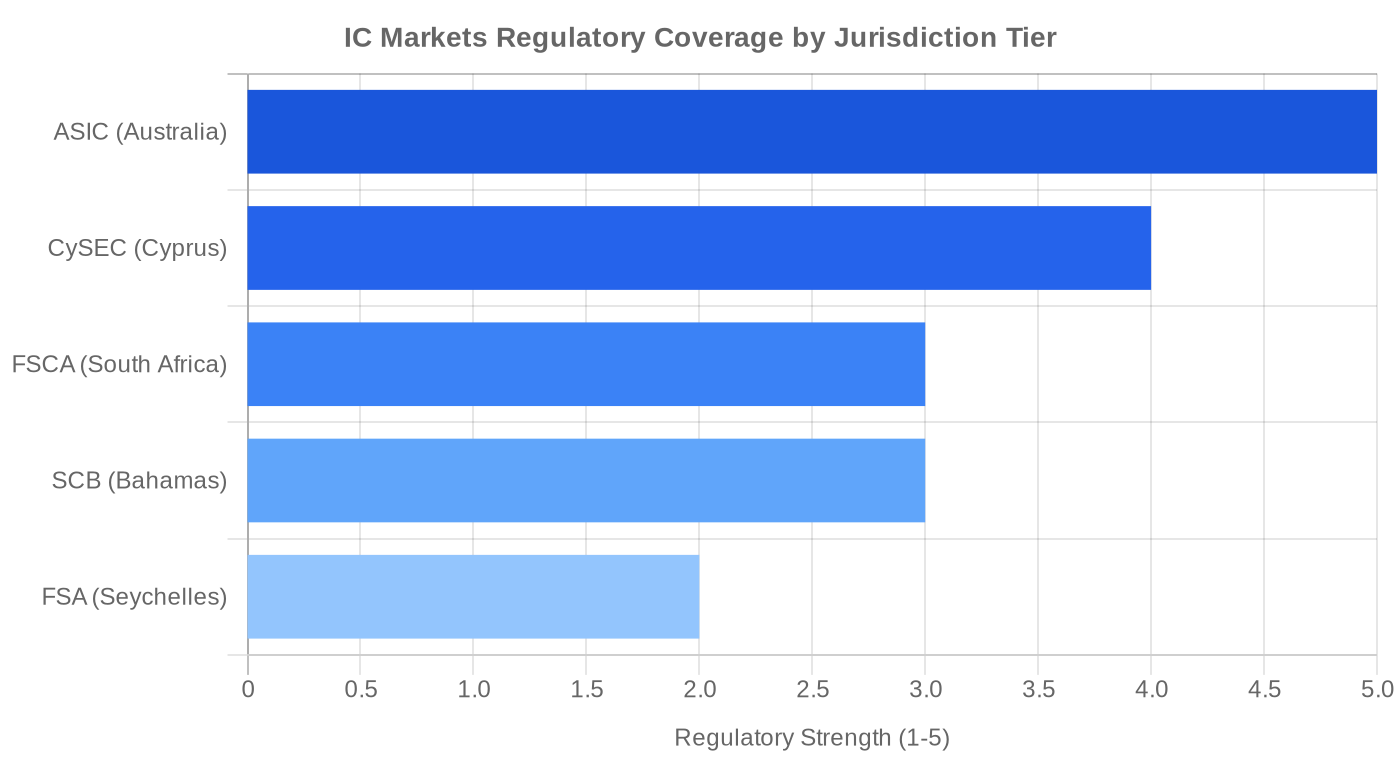
IC Markets holds regulatory licenses from five authorities: ASIC in Australia, CySEC in Cyprus, FSA in Seychelles, SCB in the Bahamas, and FSCA in South Africa. The ASIC license under International Capital Markets PTY Ltd is the one I'd focus on — ASIC is genuinely rigorous in ways that many offshore regulators aren't.
Under the ASIC license, client funds are held in segregated accounts with Westpac Banking Corporation and National Australia Bank (NAB). IC Markets is also a member of the Australian Financial Complaints Authority (AFCA), which gives clients a formal, independent complaints channel outside the broker.
One thing worth flagging: there's no investor compensation scheme covering IC Markets clients in the event of insolvency. This is standard for ASIC-regulated brokers and a known gap in Australian financial regulation compared to, say, the UK's FSCS (which covers up to £85,000 per client). It's not a deal-breaker given the segregated funds structure, but it's something to know going in.
For CySEC-regulated accounts, EU client protections apply — including negative balance protection and leverage caps in line with ESMA guidelines.
You can verify IC Markets' ASIC status directly at moneysmart.gov.au or through the ASIC Connect professional registers. It takes about 30 seconds.
What Platforms Does IC Markets Offer?
Four platforms. That's more than most regulated brokers maintain, and they don't all feel like checkbox additions — each one has a genuine use case.
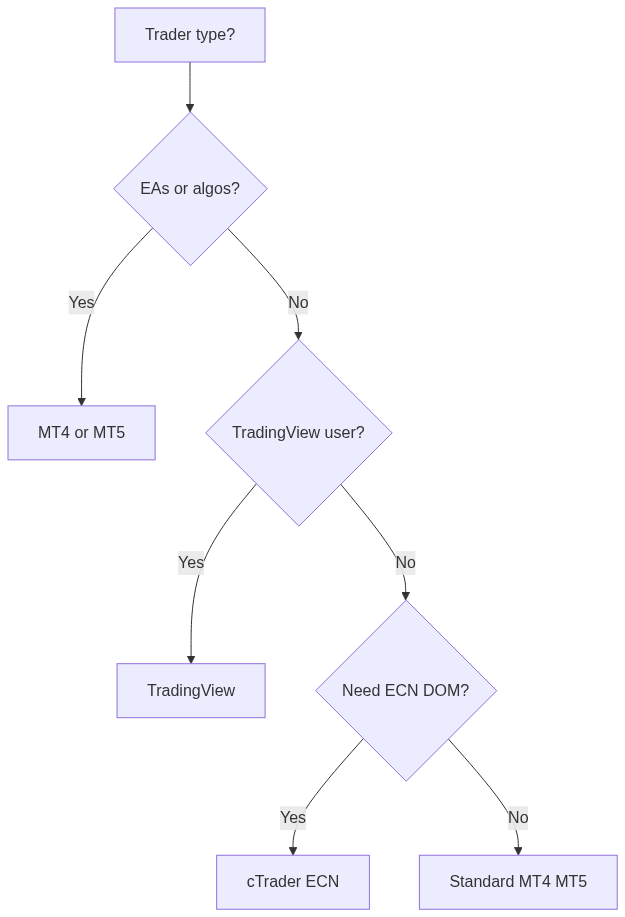
- MetaTrader 4 remains the standard for forex traders, and IC Markets' MT4 implementation is solid. The server sits at Equinix NY4 in New York, which keeps latency low for US market hours. If you use expert advisors (EAs) or you've built custom indicators, MT4 here works exactly as you'd expect.
- MetaTrader 5 builds on MT4 with more timeframes (21 vs MT4's 9), a built-in economic calendar, more order types, and broader CFD coverage including equity instruments. Traders who want a single platform for both forex and stock CFDs tend to gravitate here.
- cTrader is my preference if I'm being direct about it. The interface is cleaner than MT4 or MT5. The depth of market view is built-in and genuinely informative. Backtesting via cAlgo is more transparent than MT4's strategy tester — the methodology is documented rather than opaque. The cTrader server runs at LD5 IBX Equinix in London, which is the main liquidity hub for European forex. Worth noting: you need a True ECN account to access cTrader. It's not available on Standard.
- TradingView integration is the newest addition. If you already do your analysis on TradingView — and a lot of retail traders do — being able to execute directly from the platform without switching windows is a real convenience. ForexBrokers.com named IC Markets the #1 MetaTrader broker, but the TradingView option adds something that pure MetaTrader brokers can't match.
All four platforms are available on desktop, web browser, iOS, and Android.
Account Types: Which One Should You Choose?
Three live account types. The choice mostly comes down to how often you trade and whether you prefer predictable fixed costs or variable spreads.
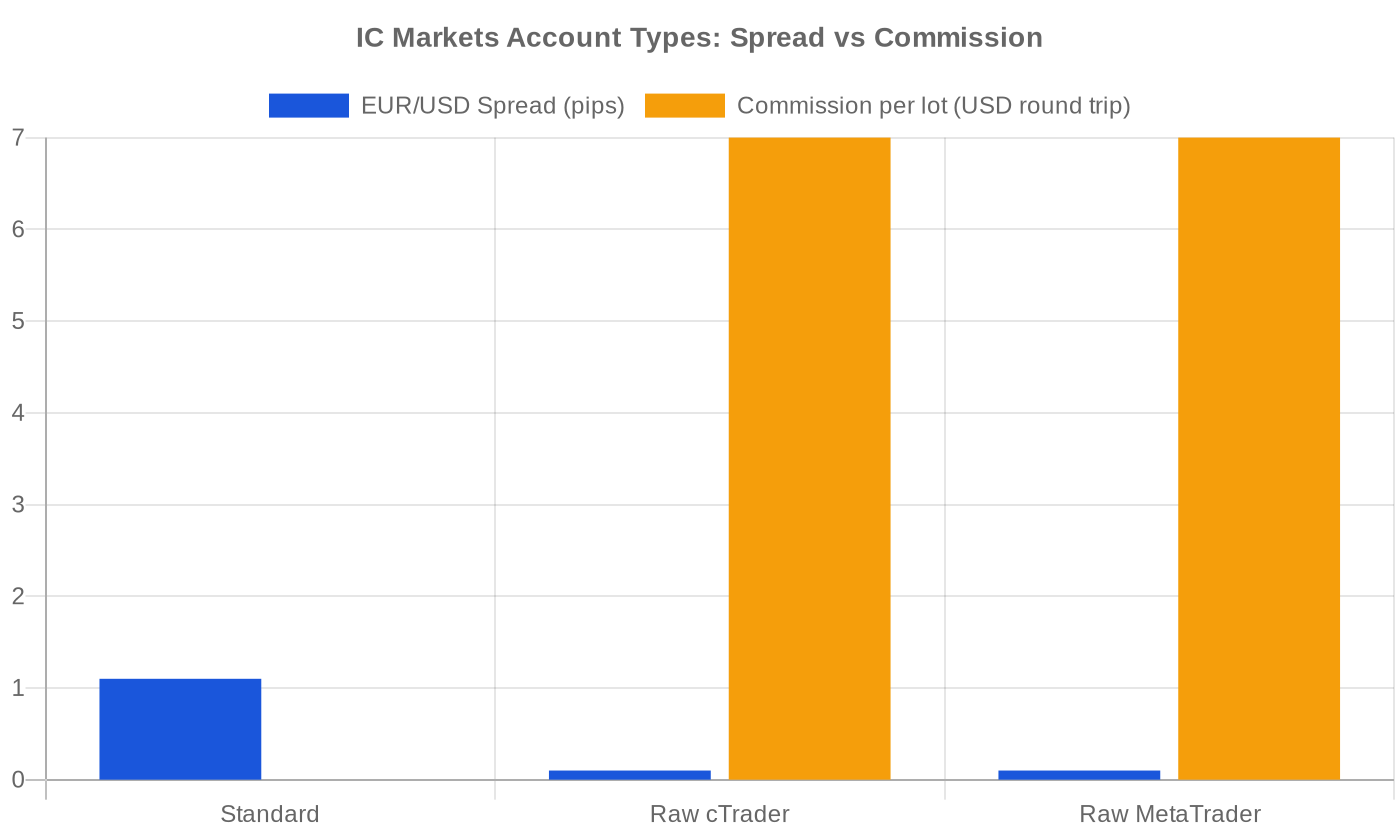
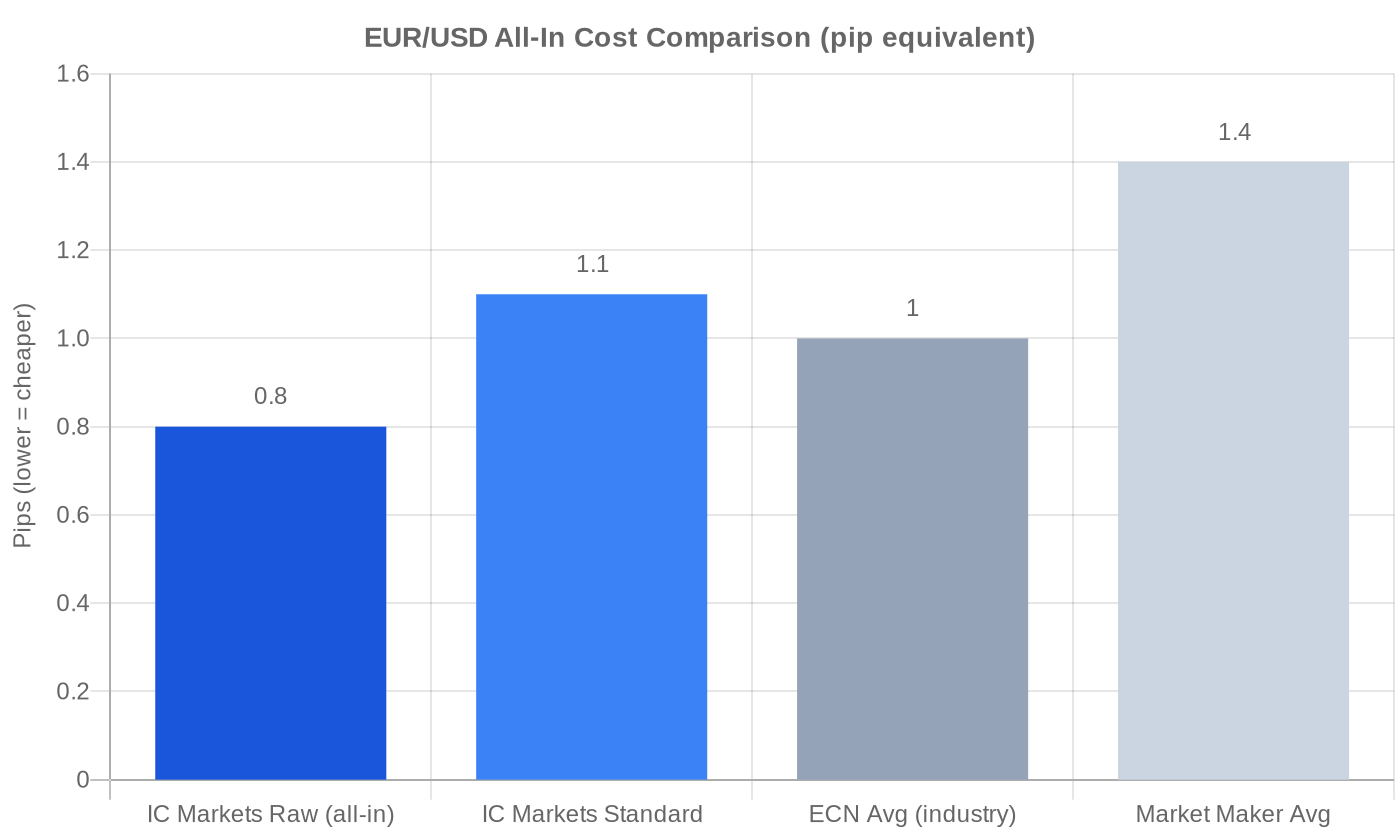
- Standard Account — No commission per trade. EUR/USD spread averages 1.1 pips. The spread includes IC Markets' margin, so what you see is what you pay. Good for swing traders or anyone who doesn't want to do math on commissions.
- Raw cTrader Account — Commission of $3.50 per lot per side ($7 round trip on a standard lot). EUR/USD spread averages 0.1 pips. At $7 round-trip commission plus a 0.1 pip average spread, the all-in cost works out to roughly 0.8 pip equivalent on a standard lot — well below most market maker spreads and competitive with any regulated ECN broker. Available on cTrader only.
- Raw MetaTrader Account — Same commission structure as Raw cTrader, but accessible via MT4 or MT5. Same spread averages. Useful if you want the Raw pricing but prefer the MetaTrader ecosystem.
Minimum deposit: $200 across all account types.
Islamic (swap-free) accounts are available on all three types. Demo accounts are available with no deposit and no time limit.
Spreads and Commissions: What Are You Actually Paying?
The Standard account spreads are competitive but not exceptional — 1.1 pips on EUR/USD is a reasonable mark for a spread-only model.
The Raw accounts are where IC Markets gets genuinely interesting. At 0.1 pips average on EUR/USD plus $7 round-trip commission on a standard lot, the all-in cost works out to approximately 0.8 pip equivalent — or $8 per standard lot in dollar terms. For comparison, a broker advertising "0.6 pip no-commission spreads" is charging $6 per standard lot — cheaper for very low-frequency traders, roughly equivalent for moderate volumes, and progressively less attractive as your lot sizes grow.
I've found the spreads hold fairly well during medium-volatility periods. During major news events (NFP, FOMC, ECB decisions), spreads widen — that's true at every ECN broker and not a specific criticism of IC Markets.
Commission-free trading applies to bonds, futures, indices, and cryptocurrencies across all account types.
Overnight swap rates are viewable within cTrader and both MetaTrader platforms before you enter a position. They vary by instrument and direction.
Some specifics on other instruments (Raw accounts):
- Gold (XAUUSD): from 0.10 spread
- DAX 40 (GER40): from 0.5
- S&P 500 (SPX500): from 0.4
- Bitcoin (BTCUSD): variable with volatility
What Can You Trade at IC Markets?
Over 3,500 instruments across six asset classes.
Forex is the main event: 60+ currency pairs. Majors, minors, exotics — the breadth is solid, and the execution quality on majors is consistently good. That's what draws scalpers here specifically.
Beyond forex: 17 indices, 4 futures, 125+ share CFDs (mainly US and Australian equities), 19+ commodities, 6+ bonds, and 10 cryptocurrencies.
The crypto coverage is limited if crypto is your primary market. Bitcoin, Ethereum, and the major altcoins are there, but dedicated crypto platforms offer more tokens and often better liquidity on smaller coins. For traders who want occasional crypto exposure alongside a primary forex/CFD strategy, IC Markets covers the basics without issue.
Social trading is available through ZuluTrade and Myfxbook AutoTrade integrations. A FIX API serves institutional clients and high-volume traders who need direct liquidity provider access.
Free VPS hosting is available for algorithmic traders running EAs 24/7 — a genuinely useful perk that saves real money if you're running automated strategies.
Deposit and Withdrawal Methods
Fifteen funding methods, zero fees.
IC Markets absorbs transfer costs on both deposits and withdrawals — which is actually unusual. Most brokers cover deposits but pass withdrawal fees back to clients, especially on card withdrawals. IC Markets doesn't, and it's worth noting.
Methods include Visa/Mastercard, PayPal, Skrill, Neteller, Bitcoin wallet, wire transfer, POLi (Australia), Klarna, FasaPay, UnionPay, and several regional options including Thai internet banking and Rapidpay.
Ten base currencies are supported: AUD, JPY, EUR, NZD, USD, CHF, HKD, CAD, GBP, and SGD.
Withdrawal timeframes:
- Instant: Neteller, PayPal, Skrill
- 3–5 business days: Credit/debit card withdrawals, wire transfer
Card withdrawals in the 3–5 business day range are standard across the industry — that's a card network processing issue, not an IC Markets-specific delay. Neteller and PayPal are instant if you want faster access.
Research and Educational Resources
Honest assessment: this is IC Markets' weakest area relative to its competition.
Research tools include Autochartist (available on MT4 and MT5) and Trading Central, which provides technical analysis signals across instruments. Both are functional; neither is exclusive to IC Markets or particularly deep.
Education is thin. There's a blog and video content on the IC Markets YouTube channel, but the library doesn't come close to IG's educational depth or CMC Markets' course structure. Beginner traders will need to source their foundational learning elsewhere — BabyPips.com covers the basics well and is free.
For experienced traders, the research gap matters less. The Autochartist alerts are useful as trade idea generators, and Trading Central's signals have a reasonable track record as supplementary input. But if you're looking for a broker that also doubles as an educational platform, look at IG or Plus500.
Customer Support
24/7 live chat, weekdays and weekends. I've tested this during European and US market hours, and the response time is consistently under two minutes. That's not common across the industry.
Phone support covers multiple countries with local numbers: Australia, UK, Germany, Spain, Indonesia, Thailand, Brazil, South Africa, Cyprus, Poland, Malaysia. That kind of geographic spread in direct phone lines is a real commitment, not just a ticket system with a marketing label on it.
A dedicated Chinese support team operates separately with its own live chat, phone (+86 400 609 6783), and email. That's relevant for the significant volume of Asian retail traders who use the platform.
Email routes to separate teams: client relations, technical support, and accounts. Same-day response for account issues in my experience; technical queries can take a bit longer.
IC Markets holds a 4.8/5 rating on Trustpilot with over 42,000 verified customer reviews, per Trustpilot's published data. That volume of reviews makes it hard to dismiss as a managed sample.
How Does IC Markets Compare to Competitors?
The two brokers most frequently compared to IC Markets are Pepperstone and XTB.
Pepperstone is the closest match. Similar ASIC/FCA dual regulation, similar ECN model, comparable Raw spread pricing. The main difference: Pepperstone's educational and research offering is stronger, and their cTrader implementation includes social copy trading natively. IC Markets edges Pepperstone on instrument count and the TradingView integration.
XTB targets beginners more explicitly — lower minimum deposit (currently $0), an in-app academy with structured courses, and a proprietary platform (xStation) that's easier to navigate than MT4 for new traders. The trade-off is xStation's depth of features doesn't match MT4 or cTrader for experienced users.
For scalpers and algorithmic traders specifically, IC Markets is my recommendation over both. The combination of Raw account pricing, sub-40ms execution, and the four-platform choice is hard to replicate.
IC Markets: My Final Verdict
IC Markets delivers where it matters most for active retail traders. The Raw account pricing is genuinely competitive. The platform choice is broader than you'd expect from a broker that still has a clean, manageable interface. ASIC and CySEC regulation covers the main entities with real client protection measures.
The gaps are real but narrow. Education is weak. Research tools are functional but not exceptional. The $200 minimum deposit keeps out some beginners who might be better served starting smaller anyway.
4.3 out of 5. For anyone who already knows how to trade and wants a tight-cost, multi-platform environment backed by a solid regulator, IC Markets is a genuinely strong choice.
Frequently Asked Questions
Is IC Markets a legitimate broker?
Yes. IC Markets holds ASIC regulation in Australia — one of the most rigorous financial regulators globally — plus CySEC, FSA (Seychelles), SCB (Bahamas), and FSCA (South Africa). It's been operating since 2007, maintains segregated client funds at Westpac and NAB, and has over 42,000 Trustpilot reviews averaging 4.8/5. You can verify the ASIC registration at moneysmart.gov.au.
What is IC Markets' minimum deposit?
$200 across all live account types. Demo accounts have no minimum. The $200 threshold applies to True ECN and Standard accounts alike.
What is IC Markets' average EUR/USD spread?
Standard accounts average 1.1 pips with no commission. Raw accounts average 0.1 pips plus $3.50 commission per lot per side ($7 round trip). The Raw all-in cost works out to roughly 0.17 pip equivalent — competitive relative to most ECN brokers.
What platforms does IC Markets support?
MT4, MT5, cTrader, and TradingView. All four are available on desktop, web, iOS, and Android. cTrader requires a True ECN account. The others work with both Standard and Raw account types.
Does IC Markets charge withdrawal fees?
No. IC Markets absorbs fees on all deposit and withdrawal methods. Card withdrawals process in 3–5 business days due to card network timelines — but IC Markets doesn't add its own fee on top.
