
The life of a trader involves structured daily routines, strict risk management, serious psychological discipline, and a lot of waiting. This guide covers what a professional trader's day actually looks like, from pre-market prep to evening journal review, and what it really takes to last in the markets.
The alarm goes off at 6 AM. Before the coffee finishes brewing, you're already checking the Asian session close on your phone. EUR/USD shifted 40 pips overnight, you want to know why. That's the life of a trader. Not glamorous. Not passive. But for the people who get good at it, genuinely one of the most mentally demanding and interesting ways to earn a living.
Most people who haven't traded assume it looks like the movies: shouting into phones, watching ticker tape, living on adrenaline. The reality is almost the opposite. The traders who survive long-term are methodical, patient, and, a lot of the time, bored.
This article covers what the life of a trader actually looks like day to day: the routine, the psychology, the tools, and the numbers nobody puts in the ads.
The Basics: Finding a Broker and Building Your Strategy
You can't trade without a broker. That much is obvious.
What's less obvious is how much the quality of your broker determines your early experience. You need a licensed, regulated broker, one registered with a recognized authority like the FCA (UK), ASIC (Australia), CySEC (Cyprus), or the NFA (US). Every one of these regulators maintains a public register. Check that your broker is on it before you deposit anything. Five minutes. Saves you from most of the scams circulating on social media right now.
When evaluating brokers, look past the homepage and check: spreads (the cost built into every trade), minimum deposit, platform stability, and execution speed. Most traders use MetaTrader 4 or MetaTrader 5. Some brokers offer proprietary platforms. Start with a demo account, you get real market data and zero financial risk. If you can't make the platform work in demo mode, you definitely can't make it work when your money is on the line.
The strategy question is non-negotiable
You need a trading strategy before you touch real money. Not a vague directional bias, an actual set of rules. What conditions trigger an entry? Where is the stop-loss? What's the take-profit target? What's the maximum loss you're willing to take in a day before you walk away?
The beginner trap is abandoning strategies too early. A strategy that hits three losing trades in a row doesn't mean the strategy is broken, it might mean you've had a bad three days. Most strategies have losing streaks. The discipline to keep following a tested plan during those stretches, while tracking the data to assess whether the drawdown is normal or a real problem, separates traders who last from traders who don't.
A Trader's Morning Routine
Most professional traders are at their desk well before their primary market opens. This isn't masochism, it's preparation. The pre-market window is where the day's analysis happens, and analysis done under time pressure is usually poor analysis.
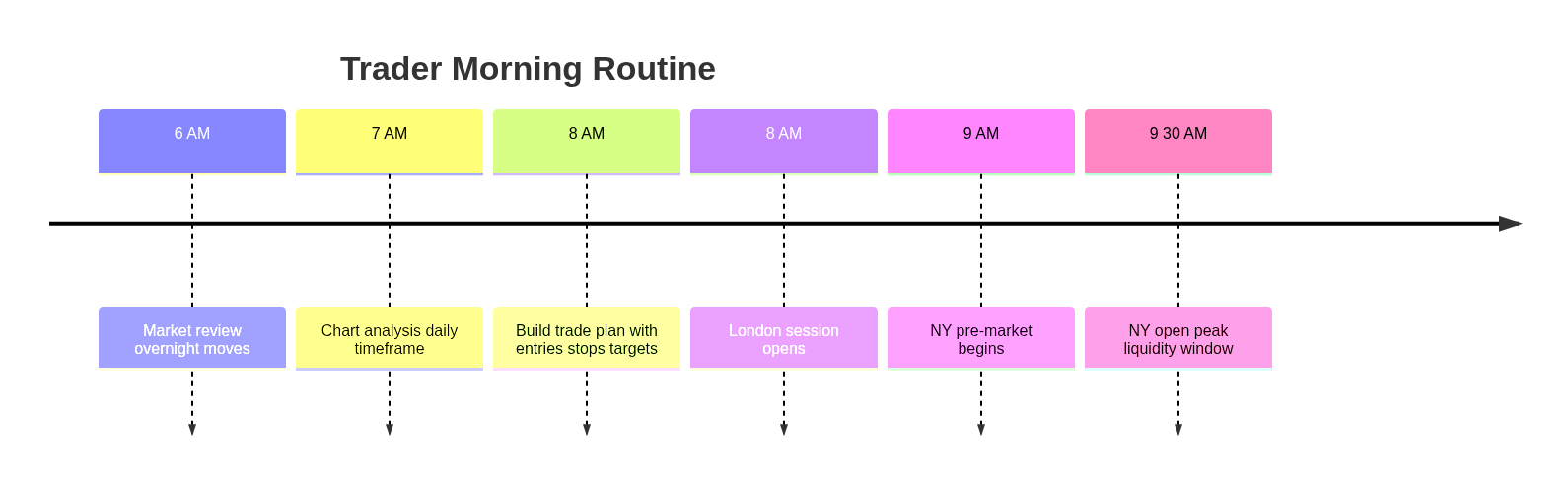
A structured morning looks like this:
- 6:00–7:00 AM, Overnight review — What happened in the Asian session? Any major data out of Japan, Australia, or China? Check the economic calendar on Investing.com or Forex Factory and flag anything that might move your pairs today. Central bank decisions, CPI data, employment reports, these events cause sharp, fast moves. You want to know about them in advance, not when they're already moving the market.
- 7:00–8:00 AM, Chart analysis — Start on the daily timeframe. Understand the broad direction before you zoom into hourly setups. Nial Fuller, a price action trader who has taught 25,000+ students since 2008, describes this as "getting the macro picture before looking for entries." Skip this step and you're making decisions without context, like reading a chapter of a book without knowing the plot.
- 8:00–9:00 AM, Build the trade plan — Specific setups you'll watch for. Price levels where you'd consider entering. Your stop-loss placement. Your target. Risk-reward ratio check. Write it down. The act of writing it down forces precision, vague plans are where discipline erodes.
The morning I stopped writing down my trade plan was the morning I learned why writing it down matters. I had a clear setup in my head, EUR/USD at a key level I'd watched for two days. I didn't write it down because I was 'sure.' Three hours later, when price hit the level and I had to decide quickly, my plan had drifted from what I'd actually intended at 7 AM. I took the trade slightly bigger than I should have, with a stop further away than I'd planned. It lost. The plan wasn't broken. The plan had never been committed to paper. Now I write it down, every time, even when I'm certain.
The London session opens at 8:00 AM GMT. This is the most liquid session for EUR and GBP pairs. Volume picks up, spreads tighten, and price moves with more directional intent than the quieter overnight sessions. Most of the day's important moves begin here.
When Markets Open: Reading the Room, Not the Feed
Here's a predictable beginner mistake: open Twitter (or X) at 9:15 AM, see several accounts posting about a big EUR/USD breakout, and jump in without your own analysis supporting the trade.
That's FOMO in action. It's also one of the fastest ways to lose money.
The experienced approach is its opposite: trade the analysis you did at 8 AM, not the narrative you read at 9:30. If your pre-market work identified EUR/USD at 1.0850 as a key support level and price reaches it during the session, that's your signal, backed by your reasoning. Someone else's tweet is not.
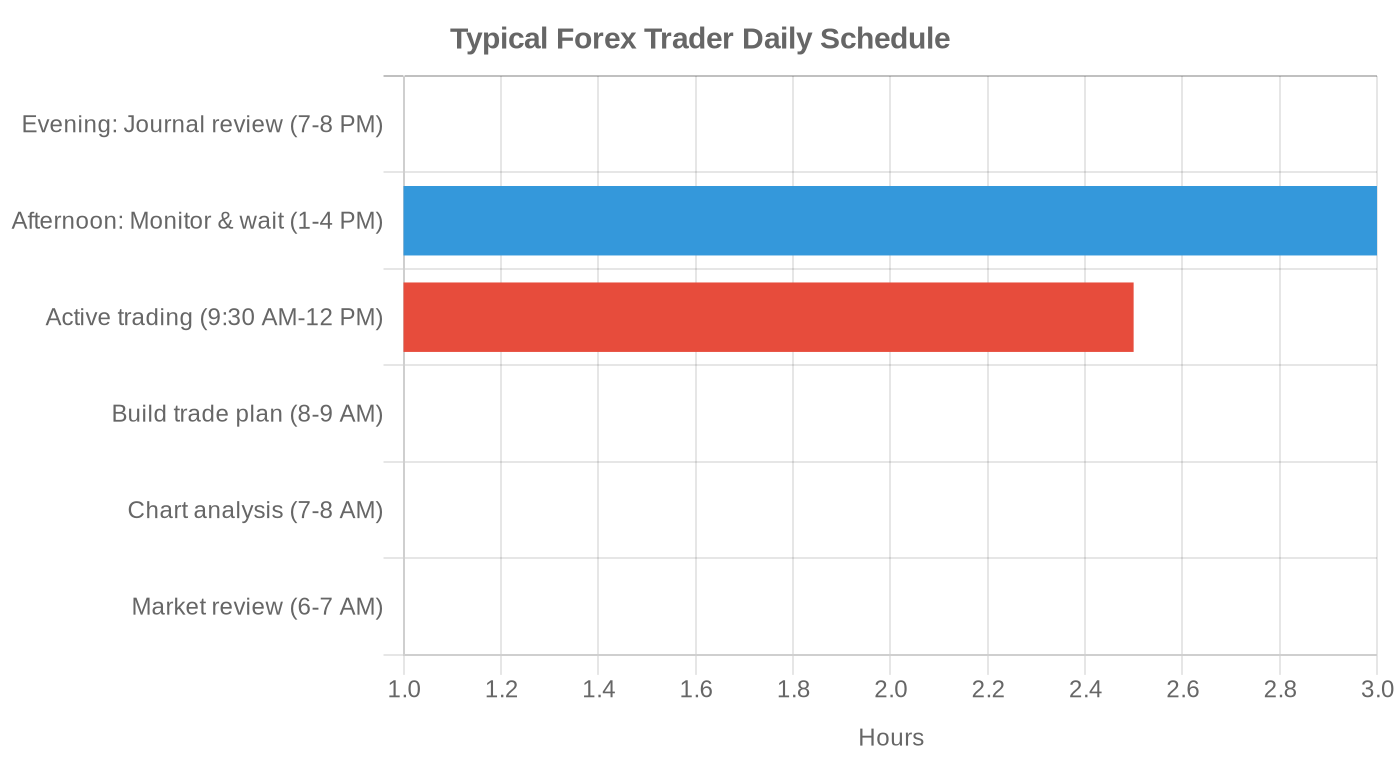
Between 8 AM and 12 PM EST, the London and New York sessions overlap. This is the highest-liquidity window of the trading day. Price movements are sharper, spreads are tightest, and setups tend to resolve faster. Most professional forex traders concentrate their active trading in this window rather than watching screens for 12 hours.
After the New York open at 9:30 AM EST, volume surges again. But here's the honest part: on most days, your pre-planned levels don't get hit. Nothing triggers. You watch, you wait, and you move on. That's not failure, that's discipline.
The Trading Day, Less Is More
The detail most new traders don't expect: professionals trade infrequently.
"More than 75% of day traders quit within the first two years," according to Quantified Strategies' 2026 analysis of long-term day trading persistence. Overtrading is one of the main drivers, taking trades just to feel active, then watching small losses compound into large ones.
Experienced traders typically place one to three trades per day at most. Many go several sessions without a single entry when conditions aren't right. What they're actually doing during the trading day:
- Monitoring open positions, checking that price hasn't hit a stop or a profit target
- Reading institutional research, understanding what the larger players are watching
- Updating watchlists, setups forming but not yet ready
- Waiting, this is most of it, and it's the hard part
The hardest skill in trading isn't timing an entry. It's doing nothing when nothing is the right call.
By mid-afternoon, volatility often softens in the US equity session. For forex traders focused on EUR and GBP pairs, the London close at 5 PM GMT frequently produces one final wave of movement as European positions are squared off. After that, things get quieter until the Asian session re-opens overnight.
"It never was my thinking that made the big money for me. It always was my sitting." — Jesse Livermore, legendary trader (in Edwin Lefèvre's Reminiscences of a Stock Operator, 1923)
Trading Psychology: The Part Nobody Warns You About
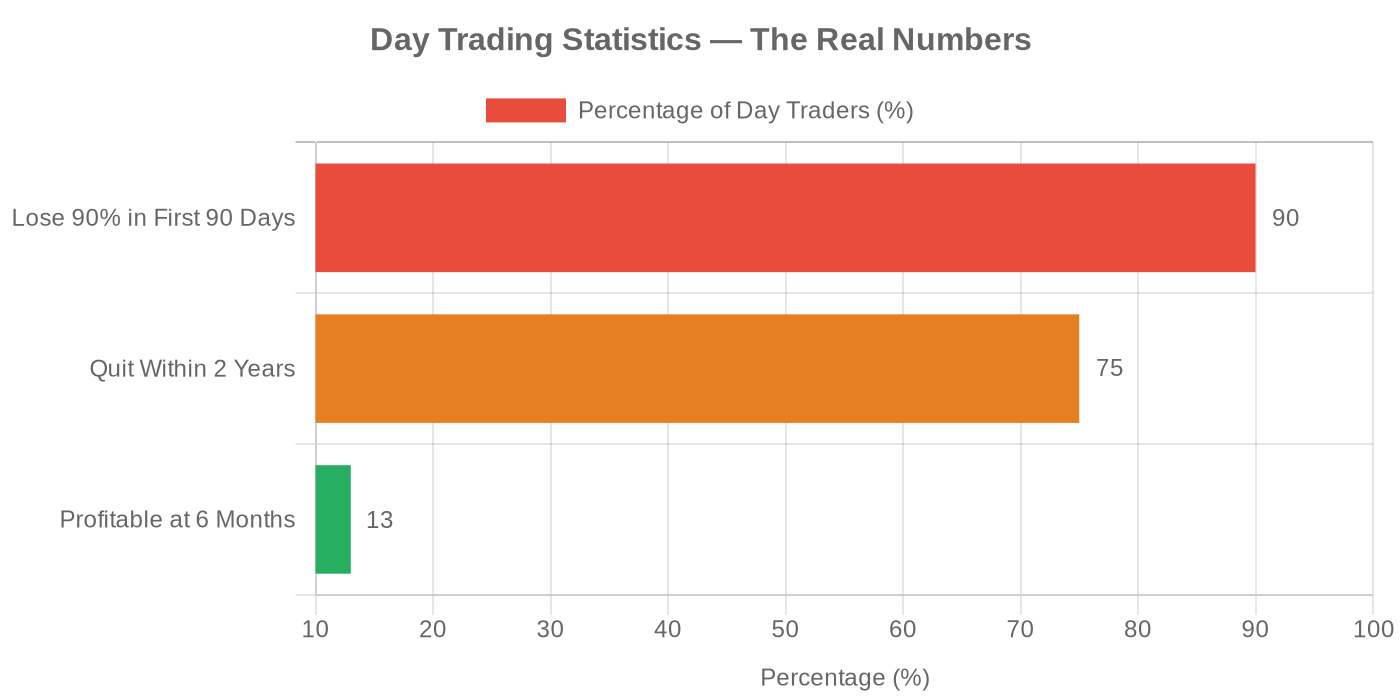
The Rule of 90 is blunt: 90% of new traders lose 90% of their starting capital within 90 days. According to FINRA data, 72% of day traders ended the year with financial losses, and only 13% maintain consistent profitability over a six-month period. These numbers exist for a reason. They're not random.
The losses in those first 90 days are rarely from bad technical analysis. They're from fear, greed, and revenge trading, taking a loss, then immediately entering a larger trade to recover it.
Revenge trading is probably the single most destructive pattern in retail trading. A $2,000 loss becomes a $12,000 loss in one afternoon because the trader couldn't step away. Every active loss is treated as an emergency rather than a normal part of the process.
Fear shows up differently. It's holding a winning trade past your target because you want more, then watching it reverse. Or hesitating on a clean setup because the previous loss is still fresh.
What separates traders who survive this period from those who don't: they treat the trading plan as genuinely non-negotiable. Entry conditions are met or they don't enter. The stop-loss is placed before emotions are involved. The target is set before the trade is opened.
FOMO, fear of missing out, is the third major trap. The forex market runs 24 hours, five days a week. There is always another pair moving, another setup forming, another opportunity 30 minutes from now. The traders who last learn this quickly. The ones who don't spend their time chasing moves they've already missed.
Risk Management: The Rule That Keeps You in the Game
The 2% rule is simple: never risk more than 2% of your total trading capital on a single trade.
On a $5,000 account, that's $100 maximum risk per trade. When that trade goes against you, and it will, you lose $100, not your account. You're still in the game tomorrow. Doesn't sound dramatic. That's the point.
This sounds obvious until you're in a losing position, down $300 and moving against you, and your brain starts arguing that the market will reverse. That is the exact moment the 2% rule stops being obvious and starts being the only barrier between disciplined trading and an account blow-up.
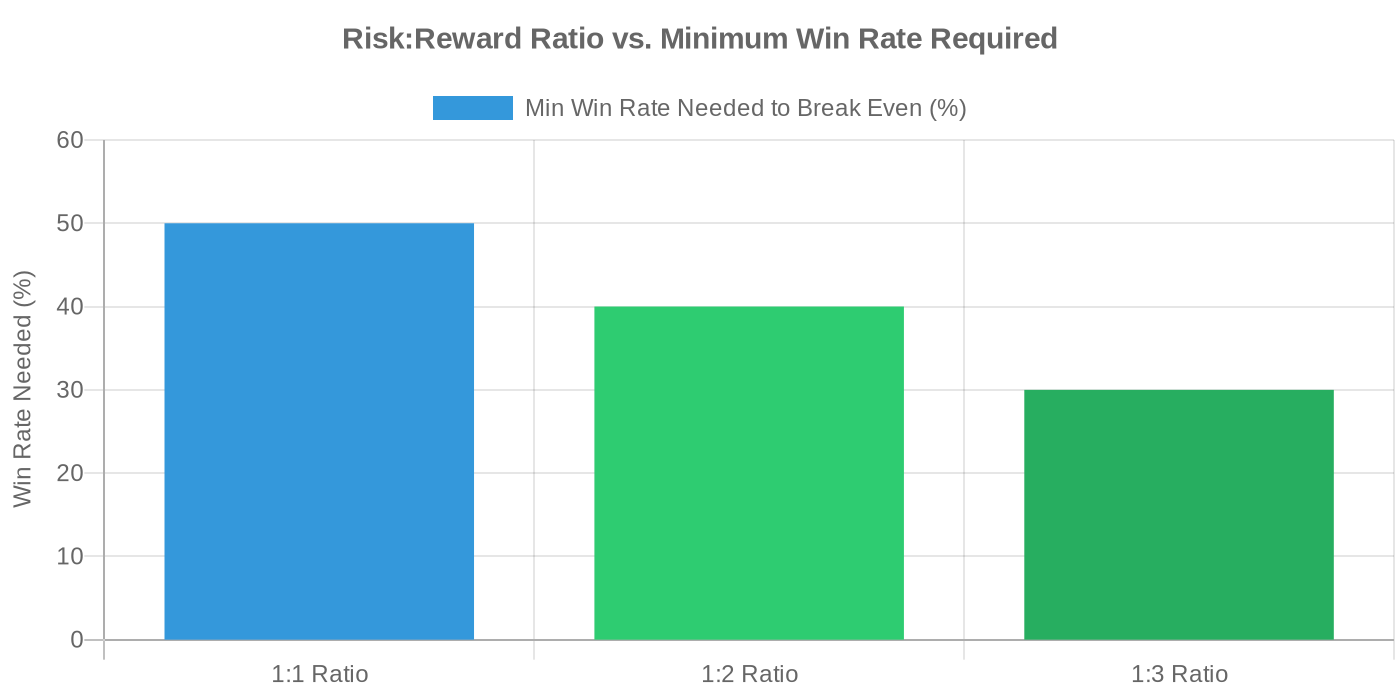
Risk-reward ratio is the other critical variable. If you're risking 1% to make 1%, you need to win more than 50% of your trades just to break even after fees. Most professional traders target at least 1:2, risk 1%, target 2%. At that ratio, you can be right on only 40% of your trades and still be profitable. Target 1:3, common in swing trading, and even a 30% win rate generates positive returns.
Stop-loss orders aren't optional. They're placed before the trade opens. Not when the trade is already moving against you. Always.
Using a Trading Journal (And Why It Actually Matters)
A trading journal is where losing traders become profitable ones.
That's not an exaggeration. Raw P&L numbers tell you whether you made or lost money. The journal tells you why. Were you tired when you entered? Were you bored? Were you following the plan or improvising? Reviewed over 50–100 trades, that data reveals patterns that the account balance alone never shows.
One trader documented by FBS Academy tracked 973 orders in a single month, generating nearly $9,000 net profit with a consistent 1:3 risk-reward ratio. That kind of result doesn't come from talent alone, it comes from systematic tracking and review.
A basic journal entry should include:
- Date, session, and market conditions
- Asset/pair and direction (long or short)
- Entry price, stop-loss level, take-profit target
- Outcome (in pips and dollar value)
- Did you follow the plan exactly? (Yes or No, be honest)
- One thing you'd do differently
Review weekly. The goal isn't to criticize losing trades, it's to distinguish between losses from bad setups and losses from good setups that simply didn't work out. Those are different problems requiring different fixes. Treating them the same is how traders stagnate.
Weekend Work: Strategy Review and Mental Reset
The markets close Friday at 5 PM EST. For most traders, this is when the real review work starts.
Weekly tasks:
- Review the week's trades in the journal, what worked, what didn't, why
- Identify setups that formed but weren't taken (and whether that was disciplined or avoidant)
- Update the watchlist for the coming week
- Check the economic calendar for high-impact events: central bank decisions, CPI releases, employment reports
- Assess any changes to open strategy rules that week's data suggests
And then: step away.
The traders who last long-term protect their mental energy as deliberately as they protect their capital. The market will be there Monday. Being rested and clear-headed Monday morning is worth more than three extra hours of chart analysis on Sunday night. That's not motivational advice, it's operational reality. Fatigue in trading produces impulsive decisions, which produce losses, which produce revenge trading.
Conclusion
The life of a trader isn't passive income. It doesn't get easy. But it does become manageable, and for those who do the structured work upfront, genuinely rewarding. Build the routine. Follow the rules. Review the results. The market rewards the patient and punishes the impulsive, consistently enough that the pattern holds over any reasonable sample of time.
Frequently Asked Questions
What does a typical trader's day actually look like?
Most professional traders work 4–6 focused hours rather than 12-hour screen sessions. Morning is analysis and planning. Active trading concentrates during peak liquidity sessions, especially the London/New York overlap (8 AM–12 PM EST). The rest of the day is monitoring open positions and waiting. Most of the day is waiting.
How much money do forex traders make?
Income varies widely. According to ForTraders, the average annual income for funded traders in the US is $96,774, but only 7–15% of applicants pass initial funded trader evaluations. Most new traders lose money in year one. Consistent profitability typically requires 6–18 months of disciplined practice.
Is trading really like gambling?
No, but only when done correctly. Trading with a tested strategy, systematic risk management, and a journal is demonstrably different from gambling. Trading on gut instinct with no stop-losses and no plan is functionally gambling. The distinction matters. The discipline required is what most people underestimate.
What tools do professional traders use every day?
Trading platform (MT4, MT5, or broker-proprietary), economic calendar (Investing.com or Forex Factory), charting software (TradingView is popular for analysis), broker research, and a trading journal. Multi-monitor setups are common but not required. A single good monitor with a clean workspace beats a cluttered six-screen setup any day.
How long does it take to become a consistently profitable trader?
Longer than most people expect. More than 75% of day traders quit within two years. Of those who persist, most reach consistent profitability somewhere between 6 and 18 months of serious, structured practice, with a journal, a real strategy, and actual capital at risk (not just demo trading). There is no shortcut that doesn't circle back to losses.
Can you trade forex part-time?
Yes. The 24/5 forex market makes part-time trading structurally possible. Many traders build their routine around the London or New York sessions from home, fitting it around a day job. The challenge is discipline, the urge to check the markets constantly during work hours is real, and managing that impulse is part of the job.
Risk disclaimer: Trading forex and financial instruments involves significant risk of loss. Past performance is not indicative of future results. Never trade with money you cannot afford to lose.
