
You open a trade with 20% of your account. The setup looks clean on the chart — price has bounced from this level three times before, the trend is clear, and you feel certain. Two hours later, price gaps through your entry and you're staring at a 20% drawdown.
That's not bad analysis. That's a position sizing problem.
Most traders who blow their accounts aren't bad at reading charts. They're bad at controlling how much they lose when they're wrong. Forex markets move fast, leverage amplifies everything, and a few bad trades at the wrong size can undo weeks of careful work. Forex risk management is the system that stops that from happening — not by preventing losses, but by keeping each loss small enough that you survive to trade another day.
The rules aren't complicated. What's hard is following them when every trade feels like a sure thing.
What Is Forex Risk Management?
You've probably searched that question after a painful loss, not before. That's the most common entry point.
Forex risk management is everything you do to control how much of your capital is exposed at any moment — per trade, per day, per open position. It covers position sizing (how many lots you trade), stop-loss placement (where you exit if you're wrong), risk-reward targets (what you expect to make relative to what you risk), and how you handle drawdown when trades run against you.
Without a risk management framework, even a technically solid strategy bleeds out. You can have a 60% win rate and still destroy an account if your losing trades are three times larger than your winners. I've seen traders post impressive demo results — 20-trade winning streaks — then give back everything on a live account in a week. The strategy didn't change. The stakes did.
Why Most Forex Traders Blow Up Their Accounts
74 to 89% of retail CFD accounts lose money. That's a regulatory disclosure range — ESMA (European Securities and Markets Authority) requires European brokers to publish their retail loss rates. It's not industry gossip.
The specific numbers by broker: IG Markets reported 76% of retail clients lost money during the measured period. eToro's 2024 figures put it at 77%. Plus500's 12-month data showed 80%.
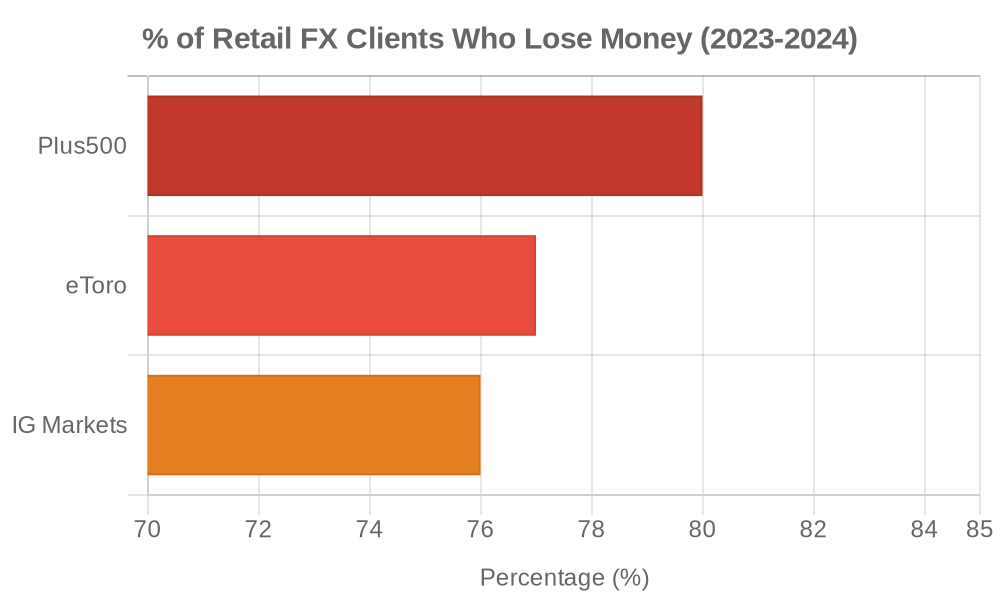
What drives those numbers? Rarely a strategy that's fundamentally wrong. Usually a combination of three things:
- Positions too large relative to account size
- No stop-losses, or stop-losses ignored when price gets close
- Inconsistent sizing — risking 2% on Monday and 15% on Friday when a trade "feels different"
The uncomfortable math: if you risk 20% per trade, you need just five consecutive losers to wipe out your account. Every trader hits a five-loss streak eventually. At 2% per trade, you'd need 50 consecutive losses to reach zero. Not impossible, but you'll have time — and capital — to diagnose what's wrong before it's too late.
The 2% Rule: How Much to Risk Per Trade
The 2% rule is the most widely adopted position sizing rule in retail forex: never risk more than 2% of your total account balance on any single trade.
On a $10,000 account, that's $200 per trade. On a $1,000 account, it's $20. That sounds small — it's meant to.
CME Group includes the 2% rule in their official trade and risk management education curriculum. Most professional retail traders operate in the 1–2% range. Institutional desks typically go lower, often 0.5–1% per position, with additional portfolio-level limits on top.
Why 2% and not 5% or 10%? Recovery math.
After a 10% drawdown, you need an 11.1% gain to get back to flat. After a 20% drawdown, you need 25%. After 50%, you need 100%. Losses don't work symmetrically — the bigger they are, the harder recovery becomes.
At 2% risk per trade and a streak of 10 consecutive losers, your account is down about 18%. Painful, but survivable. You can review your strategy, adjust, and come back. At 10% per trade, the same streak ends your account at ~65% down — psychologically and practically very difficult to recover from.
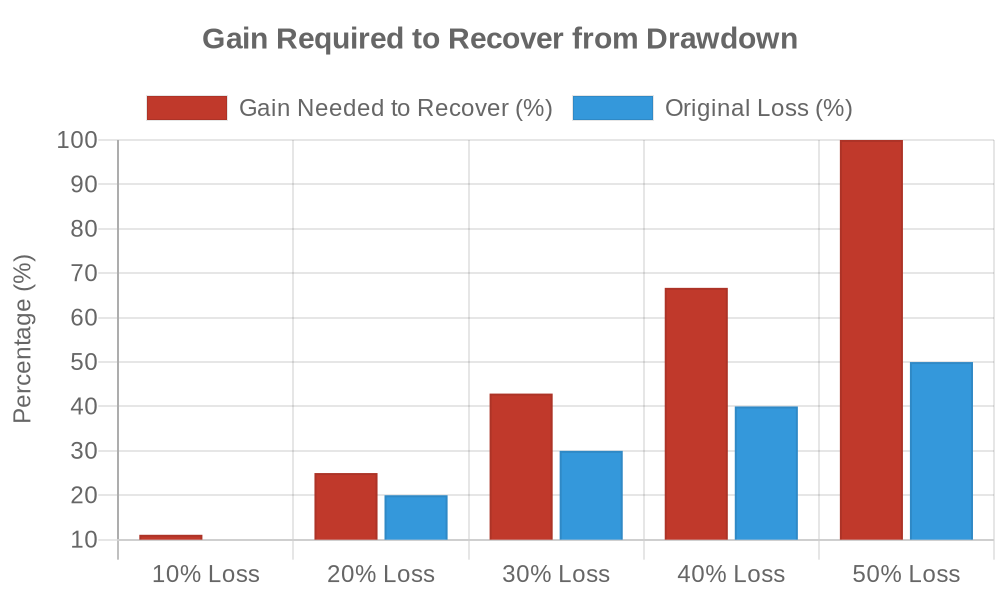
Honest observation: most beginners dismiss the 2% rule as too conservative because they've been trading demo accounts where consequences aren't real. Once you're trading real money, "conservative" stops feeling like a weakness.
Stop-Loss Orders: The Rule Enforcement Mechanism
A stop-loss is an instruction placed in the market that automatically closes your trade when price hits a set level. It's how the 2% rule actually gets enforced — not by willpower, but by an order that's already in place before you walk away from your screen.
Without a stop-loss, "I'll cut this trade if it hits X" turns into "let me give it a bit more room" turns into "I'll just hold until it comes back." Every trader who's blown an account knows that narrative.
Three methods for placing stop-losses:
- Technical stops sit below a support level or above resistance. Price breaking through that level means your thesis is wrong — the reason you entered the trade is gone. Cut it.
- Percentage stops work backwards from your 2% risk limit. You calculate the maximum pip loss you can afford, then set your stop at that distance from entry. Simple, systematic, no interpretation needed.
- Volatility stops use ATR (Average True Range) — a measure of how much a pair typically moves. Setting a stop at 1.5× ATR gives the trade room to breathe without getting whipsawed by normal daily noise.
In practice, most experienced traders combine methods: find the nearest logical technical level first, then check whether that distance produces a manageable position size at 2% risk. If the technical stop requires you to trade a size that risks 5%, either reduce the size or skip the trade.
One thing most guides don't say clearly: where you place the stop-loss determines what position size you can trade, not the other way around. Figure out the stop first.
Risk-Reward Ratios: Why You Don't Need to Win Most Trades
Here's math that surprises most traders the first time they see it.
- At a 1:1 risk-reward ratio — risking $100 to make $100 — you need to win more than 50% of trades just to break even, before spreads and commissions eat into that.
- At a 1:2 ratio (risk $100, target $200), you break even at a 34% win rate. Win 40% of trades and you're profitable. At 1:3, the break-even drops to 25%.
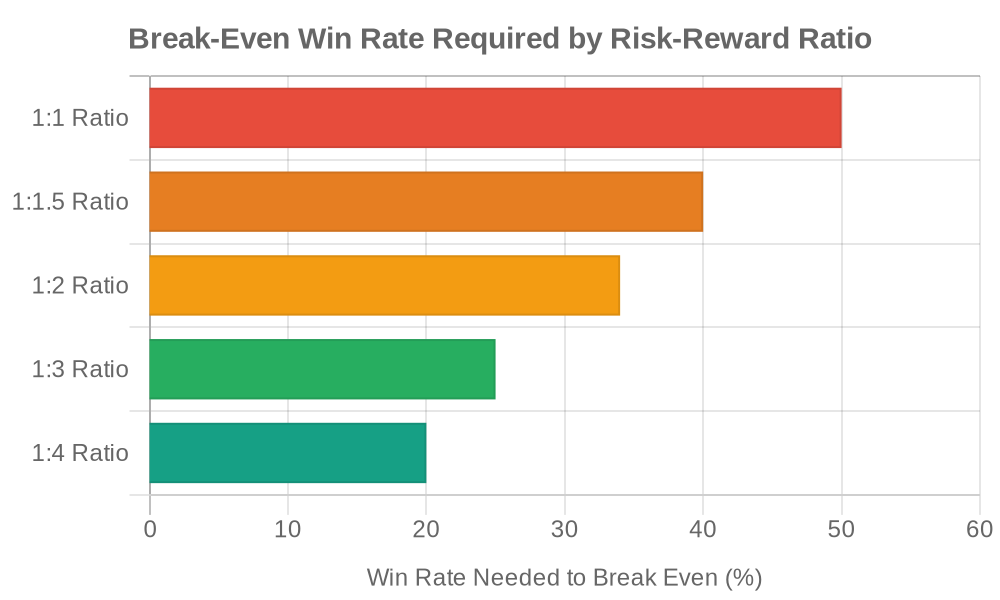
What this means in practice: a trader winning 40% of trades at 1:3 R:R makes more money than a trader winning 60% at 1:1. Most people approach trading thinking they need to be right most of the time. That's not true once the math is set up correctly.
The minimum most professional traders recommend is 1:2. Below that, your strategy is working against the arithmetic. Above 1:3, entries become harder to find but your overall performance can stay strong even through losing streaks.
Worth noting: a high risk-reward ratio doesn't mean setting an enormous take-profit and hoping. It means finding trades where the logical profit target is genuinely 2–3× the distance to your stop-loss. If the structure doesn't support it, force-fitting a 1:3 label onto a 1:1 setup doesn't change the outcome.
Position Sizing: The Calculation Before You Enter
Position sizing is how you translate "I want to risk 2% of my account" into a specific lot size. Skip this calculation and you're picking a round number and hoping it roughly matches your risk parameters. It usually doesn't.
The formula:
Position Size = (Account Balance × Risk %) ÷ (Stop-Loss Pips × Pip Value)
Working example on a $10,000 account trading EUR/USD:
- Account balance: $10,000
- Risk amount (2%): $200
- Stop-loss distance: 50 pips
- Pip value for 1 standard lot EUR/USD: $10/pip
Position size = $200 ÷ ($10 × 50) = $200 ÷ $500 = 0.40 lots
Not 0.5 lots, not 1 lot — exactly 0.40. That specific number is what makes the math work. If you round up to 0.5 lots, you're risking $250, which is 2.5% of account — a 25% increase in actual exposure.
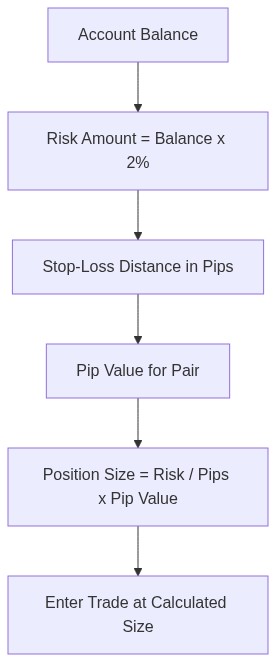
Free position size calculators on Myfxbook.com and Babypips.com will do this instantly once you input your account balance, risk percentage, currency pair, and stop-loss distance. No reason to do it manually every time — but understanding the underlying formula helps when a result looks unexpected.
One more thing: pip value differs by currency pair. EUR/USD is $10/pip for a standard lot. USD/JPY, GBP/USD, AUD/USD all have slightly different values depending on current exchange rates. The calculators account for this automatically.
The Demo Account Trap
This rarely gets talked about directly, so it's worth addressing.
Many traders open demo accounts with $100,000 or $500,000 in virtual capital and use them like video games — maximum position sizes, lots of open trades, no real consequence if something blows up. Just reset and try again. There's nothing wrong with practicing on a demo account. The problem is how you practice.
When you spend weeks trading $100,000 demo positions that you'd never open on a real $2,000 account, you're building habits without consequences. Your brain learns to make decisions at that scale. Then you go live, open positions with the same instincts you developed on demo, and get emotionally crushed when real money moves against you.
I've seen this pattern more times than I can count on trading forums. The trader swears the demo strategy was profitable. And often it was — in a consequence-free environment with unrealistic sizes. The same strategy on a live account fails not because the analysis changed but because the psychology did.
Fix: practice on demo accounts with the exact balance and position sizes you plan to use live. If your real account will be $2,000, set up a $2,000 demo with 2% risk rules from day one. Your goal isn't to run up a fake $100,000 — it's to build habits you can carry into real trading without relearning everything under pressure.
The first priority as a trader is to survive. Then get consistent. Then optimize for returns. Skipping the first two by treating demo trading as consequence-free gambling is exactly how you end up repeating the same expensive mistakes on a real account.
Frequently Asked Questions
How much should I risk per trade in forex?
The standard recommendation is 1–2% of your account balance per trade. At 2%, you need 50 consecutive losing trades to lose your entire account — which gives you plenty of time to identify what's wrong with your strategy and adjust. Many professional traders operate at 1% or below.
What is a good risk-reward ratio for forex trading?
Minimum 1:2 — meaning your target profit is at least twice your potential loss. At that ratio, you break even at a 34% win rate. A 1:3 ratio drops the break-even win rate to 25%, which makes a meaningful difference over a large sample of trades. Below 1:2, the math is working against you.
Do I need to use a stop-loss on every trade?
Yes. Every time. A stop-loss enforces your risk rules automatically — it removes the in-the-moment decision of when to cut a losing trade. Experienced traders who trade without stop-losses are usually running institutional-scale positions with built-in risk controls. For retail traders: always set a stop before the trade goes live.
What is drawdown in forex trading?
Drawdown is the percentage decline from your account's highest value. If your account peaks at $12,000 then falls to $9,600, your drawdown is 20%. Tracking drawdown tells you how severe your losing periods are — and whether your position sizing is too aggressive for your strategy's actual win rate.
What is leverage risk in forex?
Leverage lets you control a large position with a smaller deposit — at 50:1, a $1,000 deposit controls a $50,000 position. That amplifies gains and losses equally. A 1% adverse move on a 50:1 leveraged position wipes out 50% of your margin. Used correctly with proper position sizing, leverage doesn't increase your risk. Used carelessly, it multiplies losses that should have been small.
