Key Takeaways
- Four ways to trade ETH, differing in custody, cost, and leverage: spot on a centralised exchange, CFDs and futures, decentralised exchanges, and staking.
- Spot on a licensed exchange is a standard start. Fees range from 0.1% to 0.6%, depending on platform and tier.
- CFDs carry the worst odds: 50-86% of retail accounts lose money under FCA and ESMA disclosures.
- ETH dropped more than 80% from its 2021 peak. So, position sizing and stop-losses are more important than the strategy you choose.
- Staking pays yield but does not hedge price. You earn around 3.3% APY while carrying ETH's full volatility.
Ethereum is the second-largest cryptocurrency by market capitalisation. As of August 2026, ETH trades at approx $1,915 with a market cap of $231 billion and daily volume of $13.3 billion, according to CoinGecko's Ethereum Valuation Index. In this article, we'll explore how Ethereum trading works.
You can do it through spot exchanges, CFDs, or DeFi platforms. Each method carries a different cost structure and a different set of risks. Beginners usually start with a spot account on a licensed exchange. The first thing to know is what you intend to do with it once you own it.
What Is Ethereum Trading?
Ethereum trading implies speculating on a programmable blockchain. While Bitcoin primarily functions as digital cash, Ethereum is the underlying infrastructure layer for running DeFi protocols, smart contracts, and NFTs, so its valuation tracks demand for the infrastructure more than currency.
Trading ETH and buying ETH are not the same thing either. Buying means you own the underlying asset, whereas trading often means actively speculating on price through spot positions, leveraged derivatives, or on-chain swaps, each with its own risk profile, cost structure, and skill requirement. Anyone setting up a wallet on Ethereum's blockchain ecosystem meets those criteria quickly.
"What Ethereum intends to provide is a blockchain with a built-in fully fledged Turing-complete programming language that can be used to create 'contracts' … allowing users to create any of the systems described above."
— Vitalik Buterin, co-founder of Ethereum, Ethereum Whitepaper (2014)
Ethereum vs Bitcoin: Which Should You Trade?
As of August 2026, Ethereum holds approx 14.5% of total cryptocurrency market capitalization compared to Bitcoin's 57% market dominance (CoinMarketCap Global Dominance Charts). It captures nearly 55% of total value locked in decentralized finance, as per DefiLlama Multi-Chain Index, providing an execution usage driver that Bitcoin lacks.
| Metric | Bitcoin (BTC) | Ethereum (ETH) |
|---|---|---|
| Market cap (August 2026) | ~$1.29 trillion | ~$231 billion |
| Primary use case | Digital gold, Store of value | DeFi infrastructure, Smart contracts |
| Price correlation | Institutional and macro sentiment | DeFi cycles, upgrades, On-chain activity |
| Market dominance | 57% | ~14.5% |
| Daily trading volume | $25.0 B+ | $13.3B+ |
Bitcoin behaves more like a macro asset, with institutional ETF flows, dollar strength, and risk-on sentiment dominating its price. ETH reacts instead to on-chain activity: DeFi growth, gas fee cycles, and protocol upgrade timelines. In practice, Bitcoin is easier to read if you follow traditional macro signals, while Ethereum gives you the whole DeFi and smart contract ecosystem in one ticker. That breadth works both ways, since its price responds to things Bitcoin traders do not track.
What Drives the Ethereum Price?
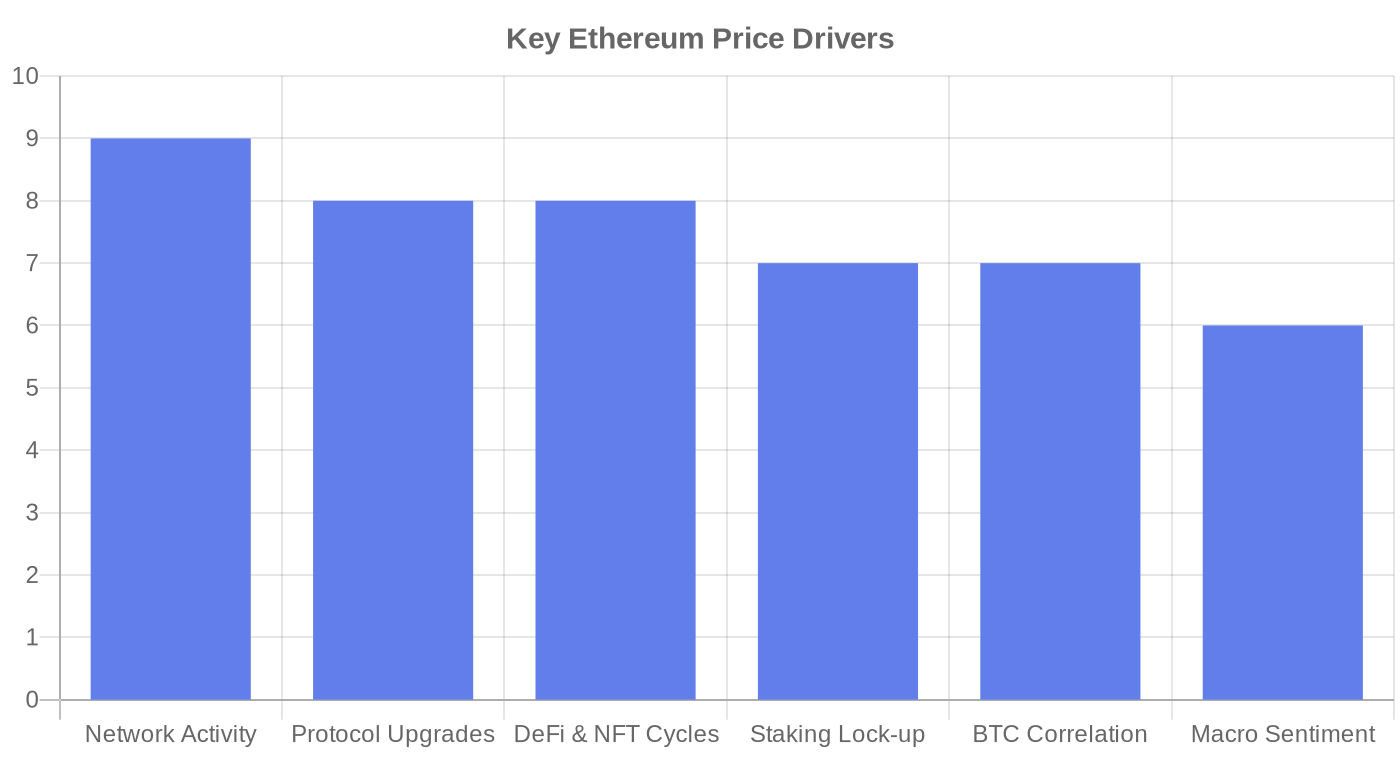
Network usage is the biggest driver of ETH's price. As of August 2026, Ethereum settles an average of 2.6 million transactions daily on mainnet, following its peak record in late 2025, with over 1 million active validators securing consensus (Etherscan). Around 32% of circulating ETH (approx 38.8 million tokens) is staked and locked off the open market, as per the Dune Analytics Staking Dashboard.
Several overlapping factors affect the price:
- Network activity and gas demand: When DeFi protocols, NFT mints, and on-chain trading fill the network, block space becomes scarce, and fees increase. It is a direct usage indicator with no Bitcoin equivalent.
- Protocol upgrades: The Merge in September 2022 ended ETH mining and switched the network to proof-of-stake. The Dencun upgrade in 2024 cut average transaction fees by nearly 95%.
- Staking and supply lock-up: With more than a quarter of supply locked away, reduced circulating supply puts upward pressure on price when demand holds. Although this is not guaranteed, it does shift the equation.
- Bitcoin price action: ETH still moves with BTC on major risk-on and risk-off events, and ignoring this is a mistake many ETH traders commit.
Main Ways to Trade Ethereum
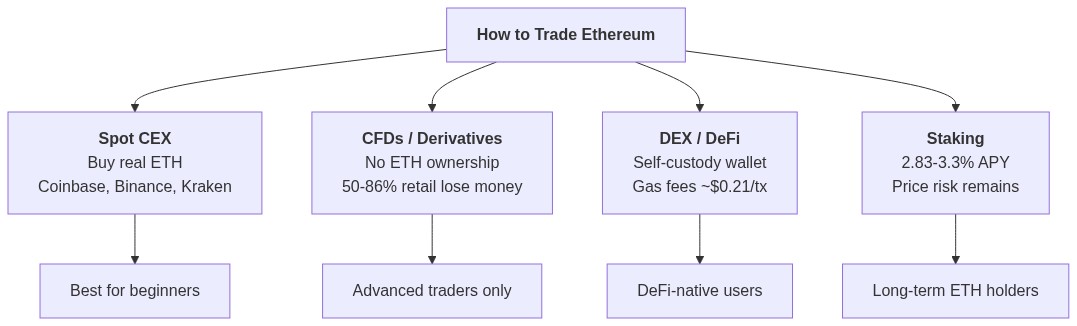
There are four ways to Ethereum trading, and the one you choose sets your cost structure, custody risk, required skill, and leverage exposure. Spot handles the bulk of ETH's daily volume, decentralised exchanges swap custody for gas costs, CFDs add leverage and the sector's worst loss rates, and staking pays yield instead of speculative returns.
Spot Trading on Centralised Exchanges
Spot trading means buying ETH at the current market price, so you own the asset while the exchange holds custody. Create an account, complete KYC, deposit fiat, buy ETH. Fees run from around 0.1% maker/taker at the low end to roughly 0.6% for basic retail users, which is minor on occasional trades but compounds quickly on active ones.
Ethereum CFDs and Derivatives
CFD: a contract for difference is a leveraged agreement to exchange the price difference of an asset between opening and closing a position, without ever owning it. Regulators require brokers to publish retail loss rates on CFD marketing material precisely because leverage magnifies losses as fast as gains.
CFDs let you take long or short positions on ETH price without holding the token, usually with leverage.
A point to note: 50-86% of retail CFD accounts suffer net capital losses based on statutory disclosure mandates published under FCA Retail CFD Restrictions. CME-listed ETH futures launched in February 2021 (CME Group Ether Futures Product Specifications), and options on those futures support more sophisticated structures, but both suit hedging rather than beginner trading, where the main risk is liquidation on a volatile overnight move.
Trading ETH on Decentralised Exchanges
DEXs such as Uniswap and SushiSwap allow direct peer-to-peer ETH swaps from your own wallet, with no KYC, no withdrawal delays, and private keys under your control throughout.
The trade-offs are a must-watch. Gas fees average around $0.21 per transaction on Ethereum mainnet (Etherscan, 2026), though Layer 2 networks such as Arbitrum and Optimism reduce it to a fraction. Large trades also face slippage, meaning the gap between the price you expect and the price you get, which on thin liquidity pairs can reach 1-3%. DEXs serve traders who are already comfortable with self-custody, because beginners who lose their seed phrase lose their funds permanently.
When our team guides people through their first DEX swap, the cost surprises them more than the self-custody feature. Everyone assumes their only worry would be the seed phrase. They rarely think about a flat per-transaction fee to make a small trade uneconomic before it even executes.
Ethereum Staking and Yield
Staking generates yield on ETH you already hold rather than speculative price returns. You can deposit ETH to assist in validating the network and earn around 3.3% APY on average across validators (Beaconcha, May 2026). Liquid staking through Lido issues stETH, a tradable derivative representing your underlying stake, yielding net returns after Lido's 10% protocol fee according to Lido Governance Documentation. However, staking does not protect you from a price drop, so you collect that 3.3% while holding ETH's complete volatility.
Steps to Start Trading Ethereum
Opening a spot account takes 15-30 minutes on most major exchanges, and you will need a government-issued ID for KYC. Most platforms accept fiat by bank transfer, debit card, or wire.
The following five steps are the whole process, and beginners usually get tripped up by treating the last one as optional.
- Choose an exchange licensed in your jurisdiction: Standards vary by country, so check the regulator's register, regardless of what marketing pages say.
- Complete KYC verification: Basic-tier verification usually processes within minutes on major platforms.
- Fund your account: Bank transfer is the cheapest. Debit card deposits are instant but carry a percentage charge.
- Place your first order: A market order buys immediately at the current price; a limit order sets your entry and waits for it to fill.
- Secure what you buy: If you plan to hold beyond a few weeks, withdraw to a hardware wallet. Several major exchanges have suffered security incidents, so exchange custody is a convenience rather than a safety feature.
"Not your keys, not your coins."
— Andreas M. Antonopoulos, author of Mastering Ethereum (2018)
In practice, beginners can get ahead with one small test buy rather than with another twenty guides. The mechanics click the first time you send ETH to a wallet address and watch it confirm on-chain.

Which Ethereum Trading Strategies Work Best?
Four approaches cover almost all retail ETH trading, and they differ mainly on time commitment. For most beginners, the honest answer is dollar-cost averaging, because the other three demand hours, capital, or infrastructure that retail traders rarely have. The table sets all four side by side, and our guide to crypto trading strategies details each in depth.
| Strategy | Time commitment | Complexity | Risk level |
|---|---|---|---|
| DCA | Low, set and forget | Minimal | Exposure to ETH price only |
| Swing trading | Medium, weekly check-ins | Moderate | Trend reversals, position sizing |
| Day trading | High, hours daily | High | Leverage, liquidation, emotional errors |
| Arbitrage | Automated | Very high | Infrastructure, execution lag |
Dollar-Cost Averaging
Buy a fixed amount of ETH at regular intervals irrespective of price, which implies you accumulate more when prices are low and less when they are high, averaging down your cost basis over time. It does not generate fast returns, and that is not its purpose either. DCA is a position-building method for people with a long-term view who would rather not carry the burden of timing entries. The risk is unchanged exposure to price, because it smooths your entry without removing downside.
Day Trading and Intraday
Day traders work fifteen-minute, hourly, and four-hour charts, watching support and resistance levels, volume spikes, candlestick signals, and momentum indicators such as RSI and MACD. Stop-losses are not optional here, because ETH can move drastically within a single session.
Swing Trading
Swing traders hold positions for days to weeks, riding medium-term trends. It needs less screen time than day trading but more market context, because you must know where ETH lies in its broader cycle instead of watching the hourly chart. Our guide to technical and fundamental analysis methods covers the toolkit, from trend lines and volume profile to exchange flows and macro context. While none of it is accurate, these are probabilistic tools that improve your odds when applied consistently.
Arbitrage
Buy ETH cheaper on one exchange and sell it higher on another. Price gaps close within seconds, so only algorithmic execution captures them consistently, which makes manual arbitrage largely theoretical for retail traders. It earns a row in the table because it keeps being sold to beginners as low-risk when the actual barrier is infrastructure.
How to Manage Risk When Trading ETH?
Ethereum dropped over 80% from its 2021 peak before recovering. During 2022, it fell from above $3,000 to below $900 in a matter of months. That is within the last four years, and it is the single most useful figure in this guide. Risk management is where most retail traders slip.
- Position sizing: Keep any single ETH trade to 1-5% of your portfolio, because beyond that, one bad position wrecks months of gains. Obvious until you are staring at a 20% overnight move on a position you sized too large.
- Stop-loss discipline: Set it before you enter. Moving a stop further out to "give it more room" is one of the most reliable ways to empty an account.
- Leverage avoidance for beginners: Those retail CFD loss rates are the base rate across regulated platforms. Prove that you can trade profitably without leverage before adding it.
- Volatility timing: ETH moves sharply around protocol upgrades, major listings, macro events, and regulatory announcements, and trading into a known volatility window without a plan is closer to gambling.
The Final Word
Ethereum trading means speculating on the largest smart contract platform in cryptocurrency markets, and the method you choose decides which failure mode you own: Exchange custody on spot, liquidation on CFDs, or a lost seed phrase on a DEX. And on staking, a yield that does nothing for you when the price halves.
Whichever you may choose, the fundamentals remain the same. Size positions sensibly, set stop-losses before entry, and do not confuse conviction in ETH's long-term value with a plan for managing short-term risk. Only one of those keeps you solvent through a drawdown.
Frequently Asked Questions
Can I trade Ethereum without owning it?
Yes, you can trade Ethereum without owning it. CFDs and futures let you speculate on ETH price movements through a contract that tracks the price rather than buying the token itself. The key is that ESMA and FCA disclosures put retail CFD account losses at 50-86%, and leverage amplifies losses as fast as it amplifies gains. For most retail traders, this is not a wise starting point.
What is the minimum amount needed to trade Ethereum?
Most centralized exchanges support fractional ETH purchases starting at $1 to $10 minimums. For decentralised trading, you also need enough ETH to cover gas fees, which run around $0.21 per transaction on Ethereum mainnet as of 2026 and considerably less on Layer 2 networks. A practical starting amount is $50 to $100 on a centralised exchange, enough to learn the mechanics without overexposing yourself.
Is it better to trade ETH actively or hold long-term?
That depends on your goals and time convenience. Active trading entails consistent hours, technical skill, and risk discipline that many retail traders underestimate, while long-term holding with periodic dollar-cost averaging ignores timing risk but leaves you completely exposed to price. Your time horizon and resilience for volatility decide it.
How is Ethereum different from Ether?
Ethereum is the blockchain network and protocol, while Ether (ETH) is the native cryptocurrency that powers it. ETH is used to pay gas fees, participate in staking, and trade on markets. Buying "Ethereum" on any exchange means acquiring ETH, the actual token. Most people and most exchanges use the terms interchangeably, which is harmless in practice, though the distinction matters when reading protocol documentation.
What are gas fees and do they affect my trading costs?
Gas fees are what you pay to process a transaction on the Ethereum network, and whether they affect your trading costs depends on where you trade. On a centralised exchange, you do not pay gas directly, since the platform absorbs network costs into its own fees. On a decentralised exchange, you pay gas in ETH on every transaction, which makes small, frequent trades disproportionately expensive. Layer 2 networks cut that cost substantially.
