You put 20% of your account at risk on one trade. The chart looks clean: price has bounced off this level three times, the trend points your way, and you feel sure. Two hours later, a news release sends price through your stop-loss, and a fifth of your account is gone.
Your read of the chart may have been right. Putting that much of the account on one idea was the error, and in our experience, it ends more trading accounts than bad analysis does.
Good forex risk management keeps the planned loss on any single trade to 1% or 2% of the account. Below, we show where that number comes from, how to place a stop-loss that enforces it, and how to turn it into an exact lot size before you place the order.
Key Takeaways
- Risk per trade: Keep it at 1% to 2% of your balance, which is $100 to $200 on a $10,000 account.
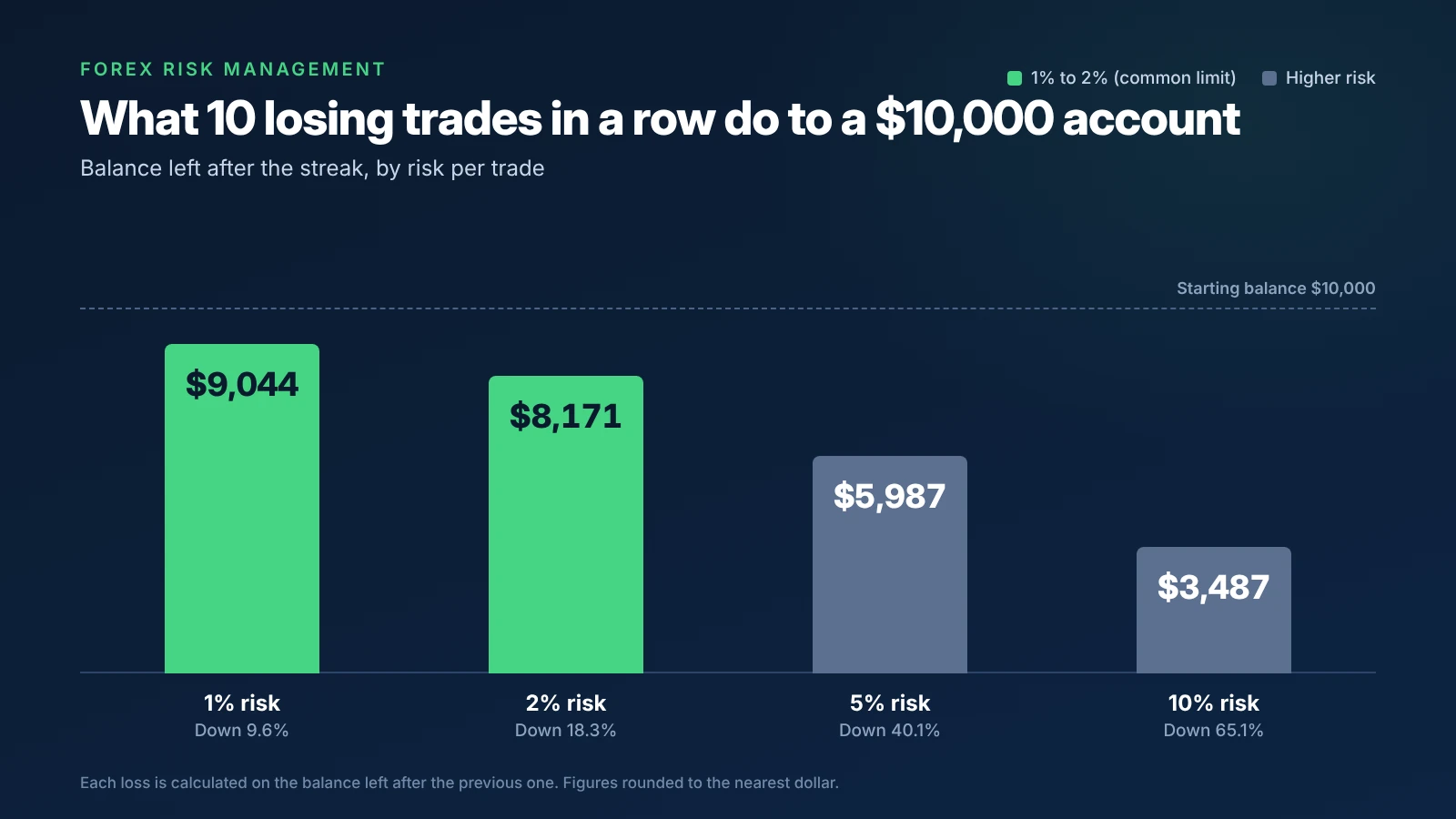
- Losing streaks: Ten straight losses cost about 18% of the account at 2% risk per trade and 65% at 10%.
- Risk-reward: At 1:2, you break even by winning one trade in three, before costs.
- Lot size: Multiply the stop distance by the pip value, then divide your dollar risk by the result. A $200 risk with a 50-pip stop on EUR/USD works out to 0.40 lots.
What Is Forex Risk Management?
Forex risk management involves a set of rules that limits how much of your account you can lose on each trade, across all open trades, and over a given month. It covers four decisions: where to exit if you're wrong (stop-loss placement), how much you aim to make compared with what you risk (risk-reward), how many lots to trade (position sizing), and how deep a losing run you'll accept before you stop and review (drawdown limits).
Why Most Retail Forex Traders Lose Money
Most of the retail forex trading in Europe runs through contracts for difference (CFDs), and the loss rates are public. When the European Securities and Markets Authority (ESMA) reviewed retail CFD trading in 2018, it found that 74% to 89% of retail accounts typically lost money. EU and UK rules now make every CFD broker publish its own figure. When we checked the brokers' UK websites in October 2026, IG showed 70%, XTB 74%, and Plus500 76%.
ESMA's review blamed the products' high leverage, complexity, and lack of transparency. On the trader's side, we see three habits behind most of the damage:
- Positions that are too large for the account
- No stop-loss, or a stop moved further away as price gets close to it
- Inconsistent sizing, such as risking 2% on Monday and 15% on Friday because a trade "feels different"
Large positions turn an ordinary losing streak into an empty account. Risk a fixed 20% of your starting balance per trade, and five straight losses wipe you out. With a 50% win rate, the odds of at least one five-loss run in 100 trades are about 81%. At a fixed 2%, it takes 50 straight losses to reach zero.
How Much Should You Risk Per Trade? The 2% Rule
The 2% rule says you should never risk more than 2% of your account balance on a single trade. On a $10,000 account, that's $200. On a $1,000 account, it's $20. The amounts look small on purpose.
CME Group teaches the rule in its Trade and Risk Management course and notes that the 2% figure is arbitrary, so traders can choose a tighter limit. Some well-known professionals go lower. Larry Hite, co-founder of the fund manager Mint Investments, told Jack Schwager in Market Wizards (1989) that "the very first rule we live by at Mint is: Never risk more than 1 percent of total equity on any trade."
Why 2% and Not 10%: The Recovery Math
Losses and gains don't cancel out.
- A 10% drawdown needs an 11.1% gain to get back to where you started.
- A 20% drawdown requires 25%.
- A 50% drawdown needs 100%, which means doubling what's left.
Ten straight losses show how fast the gap opens. At 2% of the current balance per trade, a $10,000 account ends the streak at $8,171 and needs a 22% gain to recover. At 10%, it ends at $3,487 and needs 187%.
Stop-Loss Orders: How to Enforce Your Risk Limit
A stop-loss is an order that closes your trade automatically when price reaches a level you set in advance. It enforces your risk limit when you're away from the screen and removes the in-the-moment choice that turns "I'll cut it at X" into "I'll give it more room" and then "I'll hold until it comes back."
Set the stop before you set the size, because the place of this stop decides how many lots you can trade. Traders use three main methods to place stops.
1. Technical Stops
A technical stop goes just past the level that would prove your trade idea wrong: below support for a buy, above resistance for a sell. If price breaks that level, the reason you entered no longer holds.
2. Volatility (ATR) Stops
The Average True Range (ATR) measures a pair's average price range per candle, usually over the last 14 candles. A stop at 1.5 times the ATR leaves room for normal price swings, so routine noise is less likely to knock you out of a sound trade.
3. Fixed-Risk Stops
This method runs backwards: you pick a lot size, work out how many pips your 2% allows, and put the stop at that distance. It needs no chart reading, but the stop often lands inside normal price swings and gets hit for no reason connected to your trade idea.
Experienced traders usually combine the first two methods. They find the nearest logical technical level, check that it's wider than normal volatility, and size the position so that distance costs 2% or less. If even the broker's minimum lot size would break the limit, they skip the trade.
A stop-loss doesn't guarantee your exit price. Once price reaches the stop, the order becomes a market order, and the SEC's investor bulletin on stop orders warns that the fill "can deviate significantly from the stop price." In forex, this happens most often at the Sunday open and around major news, so a gap can cost you more than the 2% you planned. Some brokers offer guaranteed stop-loss orders that close the trade exactly at your level, for a fee.
Risk-Reward Ratio: Why You Don't Need to Win Most Trades
The risk-reward ratio compares what you stand to lose on a trade with what you aim to make. Risk $100 to make $200, and the ratio is 1:2. The break-even win rate equals 1 ÷ (1 + the reward multiple), so the bigger your target relative to your stop, the fewer trades you need to win:
| Risk-reward | Break-even win rate | Result of 10 trades (4 wins, $100 risk) |
|---|---|---|
| 1:1 | 50% | −$200 |
| 1:1.5 | 40% | $0 |
| 1:2 | 33% | +$200 |
| 1:3 | 25% | +$600 |
The figures leave out spreads and commissions, which push every break-even rate slightly higher.
A trader who wins 40% of trades at 1:3 makes more than one who wins 60% at 1:1. Over 100 trades risking $100 each, the first finishes $6,000 ahead and the second $2,000 ahead, before costs.
Many trading educators treat 1:2 as the minimum, and it's the floor we'd use. But the ratio has to come from the chart. A 1:3 target only counts when there's a logical profit level three times as far away as your stop. Stretch the target on a 1:1 setup, and you lower your win rate without improving the trade.
Position Sizing: How to Calculate Your Lot Size
Position sizing turns "I'll risk 2%" into an exact number of lots, so you aren't picking a round number and hoping it fits your limit. The formula is:
Position size (lots) = (Account balance × Risk %) ÷ (Stop-loss in pips × Pip value per lot)
For a $10,000 account trading EUR/USD with a 50-pip stop, that's $200 ÷ (50 × $10) = 0.40 lots.
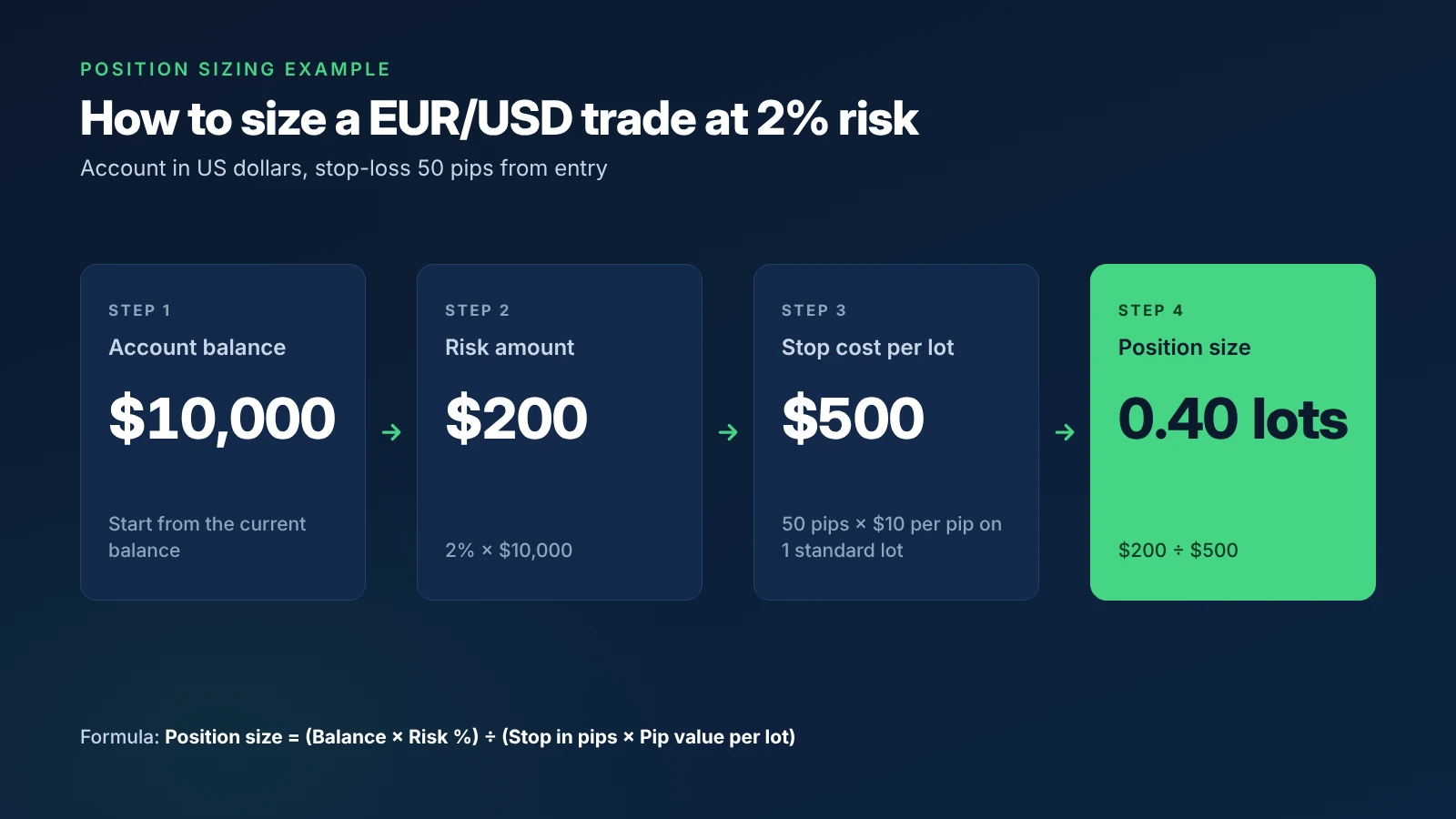
Trade exactly 0.40 lots. Round up to 0.5, and you risk $250, or 2.5% of the account, a quarter more than you planned.
Pip value depends on the pair and your account currency. On a US dollar account, any pair quoted in dollars (EUR/USD, GBP/USD, AUD/USD) is worth $10 per pip on a standard lot, $1 on a mini lot (0.10), and $0.10 on a micro lot (0.01). Other pairs move with the exchange rate. A standard lot of USD/JPY is worth ¥1,000 per pip, which came to about $6.30 with the pair near 158.50 in mid-October 2026.
Free position size calculators from Myfxbook and Babypips do this math in seconds, and our forex margin calculator shows how much margin the trade will tie up. Learn the formula anyway, so you can spot a result that looks wrong.
Where Leverage Fits
Leverage lets you open a position larger than your deposit. At 50:1, $1,000 of margin controls $50,000 of currency, so a 1% move against you costs $500, half your margin. Retail leverage on major pairs is capped at 30:1 in the EU and for UK-regulated brokers, and at 50:1 in the US.
Leverage doesn't change the dollar risk of a correctly sized trade; your stop distance and lot size set that. It does let you open a position far larger than your risk limit allows, and that's where traders get into trouble. Our guide to forex and stock trading compares how leverage works in each market.
Set Limits for Open Trades and Losing Months
The 2% rule covers one trade. Three open trades at 2% each put 6% of the account at risk at once, and the exposure grows when the pairs move together. Buy EUR/USD and GBP/USD together, and you hold two bets against the US dollar, so one strong-dollar day can stop out both.
Two more limits close that gap:
- Open risk: Treat correlated positions as one trade, so their combined risk stays within your per-trade limit, and cap total risk across everything open, for example at 5% or 6% of the account.
- Monthly loss: Alexander Elder's 6% rule, from his book Come Into My Trading Room (2002), says to stop opening trades for the rest of the month once that month's losses plus the risk on open trades reach 6% of your account.
A pause like this costs you a few weeks of trades. It also forces a review before most of the account is gone.
Practice on a Demo Account the Way You'll Trade Live
Many demo accounts open with tens of thousands of dollars in virtual money, and traders use them like a video game: maximum size, many open trades, and a reset when the balance runs out. Weeks of that train your instincts for a scale you'll never trade on a $2,000 live account.
We've seen traders post 20-trade winning streaks on demo, and then lose a large part of their first live deposit within a week. The strategy was the same, but they were still sizing trades for the demo balance.
Open your demo with the balance you plan to fund, and apply your risk limit from the first trade: on $2,000, that's $20 to $40 per trade. Once the habit holds for a couple of months, compare regulated brokers and start live at the smallest size your broker allows.
Forex Risk Management: The Bottom Line
You will lose trades, often several in a row. Forex risk management decides how much each one costs, and it only works if you run the same four checks, in the same order, before every trade:
- Stop: Find the price that would prove your idea wrong, and place the stop there.
- Target: Look for a logical profit level at least twice as far away as the stop.
- Size: Choose the lot size that makes that stop cost 1% to 2% of your account.
- Total: Add up the risk on every open trade, keep correlated pairs within one trade's limit, and stay under your open-risk and monthly caps.
If a trade fails any of the four, skip it. Another setup will come along tomorrow, and a blown account takes months to rebuild.
Frequently Asked Questions
How much should I risk per trade in forex?
You should risk 1% to 2% of your account balance per trade. On a $5,000 account, that's $50 to $100. Start at 1% if you're new or coming out of a losing run.
Is the 1% rule better than the 2% rule?
For most beginners, yes, because it cuts the damage of a losing streak roughly in half. Ten straight losses cost about 9.6% of the account at 1% risk and 18.3% at 2%. Traders with a tested strategy and steady results often move up to 2%.
What is a good risk-reward ratio in forex?
A good risk-reward ratio in forex is 1:2 or higher. At 1:2, you break even by winning one trade in three, and at 1:3, one in four. Use a ratio only when the chart shows a logical profit target at that distance.
Can you trade forex without a stop-loss?
You can, but you shouldn't. Without a stop, nothing caps the loss except your discipline at the worst possible moment, and one news spike can erase weeks of gains. Set the stop before the order goes live.
How much money do I need to trade forex with proper risk management?
You can follow the 2% rule with as little as $500 if your broker offers micro lots. Two percent is $10, which allows a 100-pip stop on 0.01 lots of EUR/USD at $0.10 per pip. On a $100 account, the same size allows only a 20-pip stop, which is too tight for most setups.
What is drawdown in forex trading?
Drawdown is the percentage fall from your account's highest value to its lowest point after that peak. If your account peaks at $12,000 and drops to $9,600, your drawdown is 20%, and you need a 25% gain to get back to $12,000.
