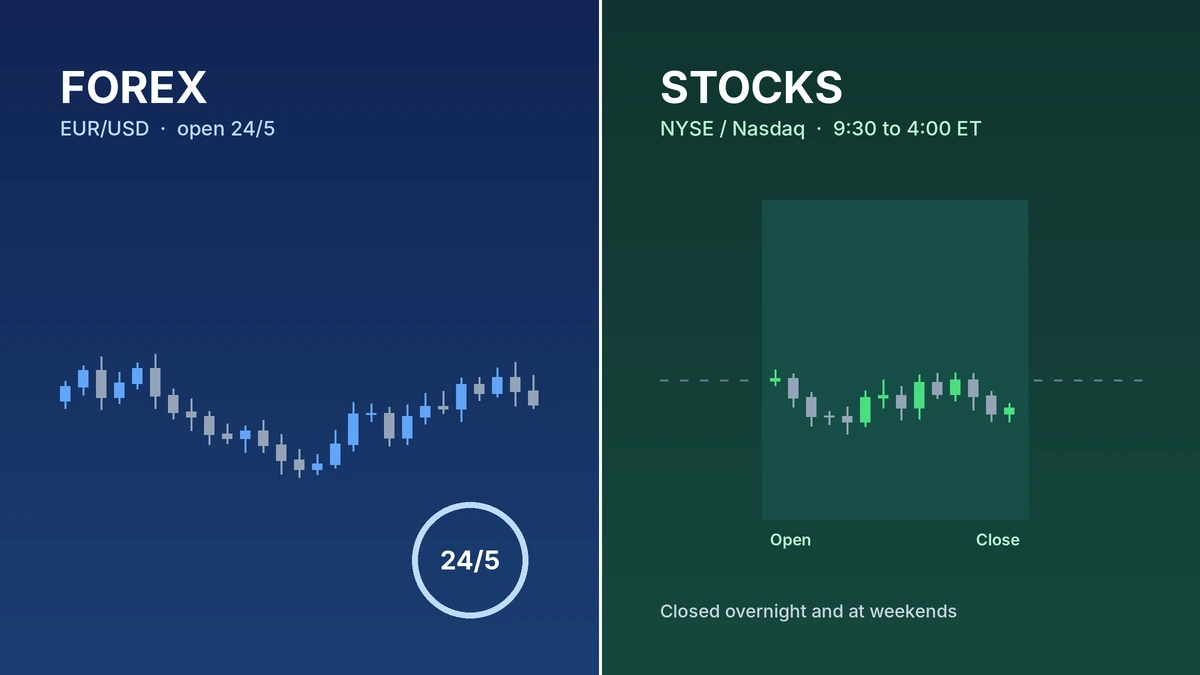
Forex trading means buying one currency against another in a market that runs 24 hours a day, five days a week. Stock trading means buying shares in companies during set exchange hours. Forex offers more leverage and more liquidity; stocks offer ownership, dividends, and stronger investor protection. For most beginners, stocks are the easier place to start.
Picture yourself in London at 11 pm on a Sunday. Can you trade? In forex, yes: the week's trading opened an hour earlier. In stocks, you wait until Monday. That one difference in hours says a lot about how the two markets work, who they suit, and how they can hurt you.
Key Takeaways
- Hours: Forex trades from Sunday evening to Friday evening; US stocks trade 9:30 am to 4:00 pm New York time on weekdays.
- Leverage: Retail forex allows up to 50:1 in the US and 30:1 in the EU and UK; buying US stocks on margin allows about 2:1.
- What moves prices: Interest rates and economic data move currencies; earnings and company news move shares.
- Protection: SIPC covers up to $500,000 at a failed US brokerage, but it excludes forex trades.
- Beginners: Stocks forgive mistakes more slowly, which gives you time to learn.
Forex vs stocks at a glance
| FOREX | STOCKS | |
|---|---|---|
| Daily trading | About $9.6 trillion (BIS, April 2025) | About $800 billion on exchanges worldwide (WFE, 2025) |
| Trading hours | Sunday 5 pm to Friday 5 pm New York time | 9:30 am to 4:00 pm New York time on NYSE and Nasdaq |
| Maximum retail leverage | 50:1 on major pairs in the US; 30:1 in the EU and UK | About 2:1 on margin in the US |
| What you trade | Currency pairs, such as EUR/USD | Shares in thousands of listed companies |
| Where trades happen | Between banks and dealers, with no central exchange | On regulated exchanges |
| What moves prices | Interest rates, inflation, central bank decisions | Earnings, company news, sector trends |
| Income from holding | None; you pay or earn a nightly interest adjustment | Dividends, if the company pays them |
| Investor protection (US) | SIPC excludes forex trades | SIPC covers up to $500,000 if a brokerage fails |
What is forex trading?
Forex, short for foreign exchange, is the market where currencies are bought and sold against each other. You always trade a pair. Buy EUR/USD, and you're buying euros and selling US dollars; the price tells you how many dollars one euro costs.
It is the busiest market in the world. The Bank for International Settlements (BIS) Triennial Survey put average daily turnover at $9.6 trillion in April 2025, up 28% from $7.5 trillion in 2022. Trading moves around the globe through the Sydney, Tokyo, London, and New York sessions, and EUR/USD, GBP/USD, and USD/JPY are the most traded pairs.
What is stock trading?
Stock trading means buying and selling shares of companies on exchanges such as the New York Stock Exchange (NYSE) and Nasdaq. A share makes you a part-owner of the company, so you can profit from a rising price and, if the company pays one, a dividend.
Because each stock is tied to one company, your research is on that particular business: its earnings, its debt, its management, and its competitors. You can buy Apple, Microsoft or Tesla because you believe in what they do, and you'll watch their results closely.
One catch for forex traders: at many forex brokers, 'stocks' are share CFDs, contracts that track a share's price without giving you the share or its dividend rights. Check the product name before you buy. Our guide to CFDs and their loss rates explains the difference.
Trading hours: 24/5 vs fixed sessions
Forex runs from 5 pm Sunday to 5 pm Friday, New York time, according to FOREX.com. If you work office hours, you can trade before work in the London session or late in the evening. US stocks trade from 9:30 am to 4:00 pm New York time on the NYSE, which is 14:30 to 21:00 in the UK for most of the year. Pre-market and after-hours trading exist, with wider spreads and fewer buyers and sellers.
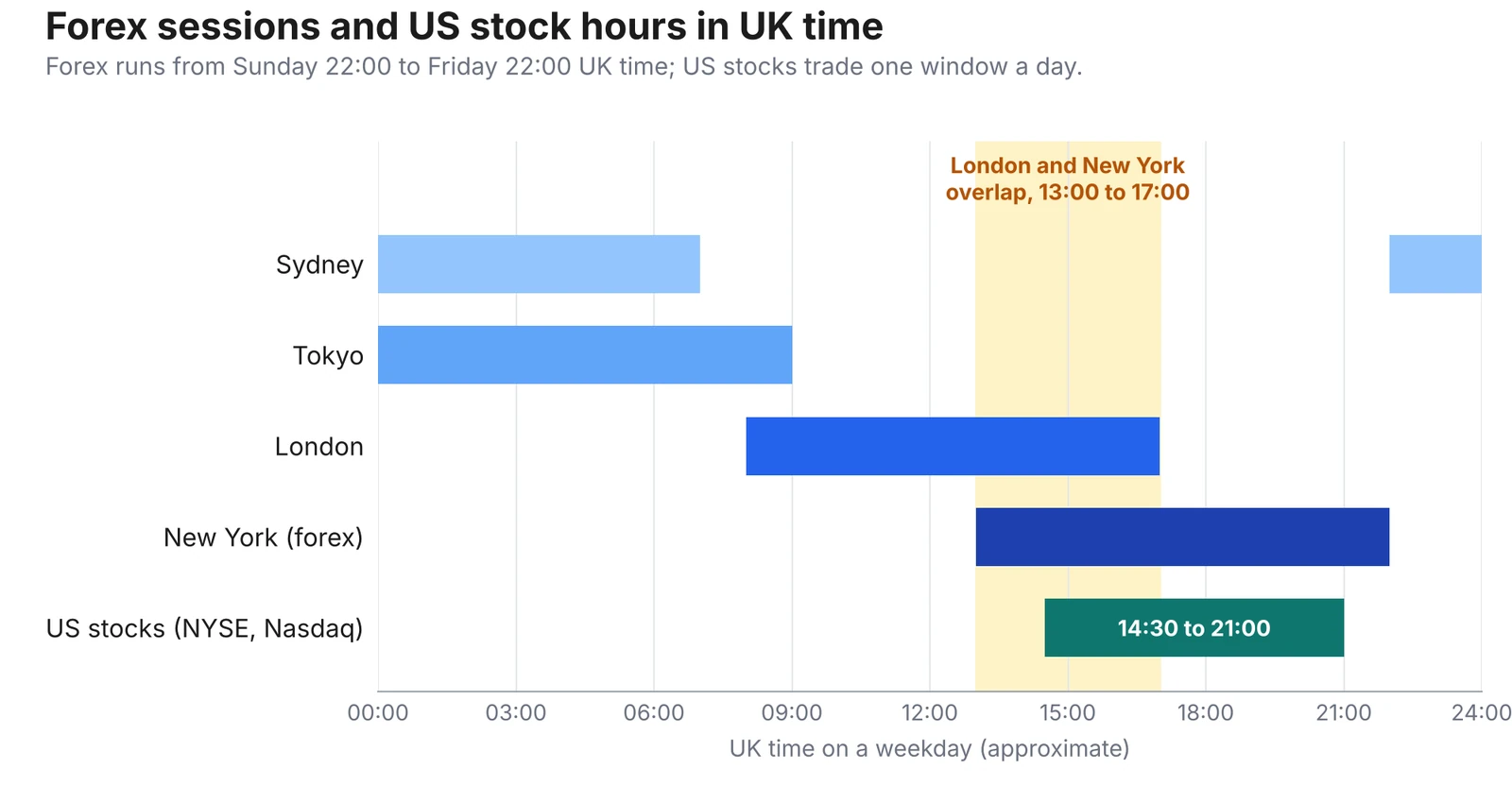
Approximate sessions in UK time on a weekday. Clock changes shift them by an hour for a few weeks a year.
Open all week doesn't imply every hour is equal. The busiest stretch for major pairs is when London and New York are both open, from about 8 am to noon New York time, 13:00 to 17:00 in the UK. IG calls it 'the most liquid period of the day'. In the quiet Asian hours, spreads on pairs such as GBP/USD can widen, so when you trade matters as much as what you trade.
Liquidity and market size
Forex is far larger in daily trading. The world's exchanges traded about $204 trillion of shares in 2025, according to the World Federation of Exchanges, which works out to roughly $800 billion a day. That is less than a tenth of daily forex turnover.
For you, the difference shows up in fills. On major currency pairs, you can usually buy or sell at or near the price you see. Stock liquidity varies by company: Apple and Microsoft trade billions of dollars a day; a small company may trade a few hundred thousand, with wide spreads and slippage on larger orders.
Leverage: more exposure, bigger losses
Forex brokers lend far more than stock brokers. Since 2010, US rules have required a minimum deposit of 2% on major currency pairs and 5% on others (CFTC), which caps leverage at about 50:1 and 20:1. In the EU, ESMA set a 30:1 limit on major pairs for retail clients in 2018, and the UK applies the same cap. For US stocks, Regulation T lets you borrow up to 50% of the purchase price, about 2:1.
What does that mean in money? With $1,000 at 50:1, you can hold a $50,000 EUR/USD position. A 1% move against you costs $500, half your account, in a single move. The same 1% fall on $1,000 of shares bought with cash costs $10.
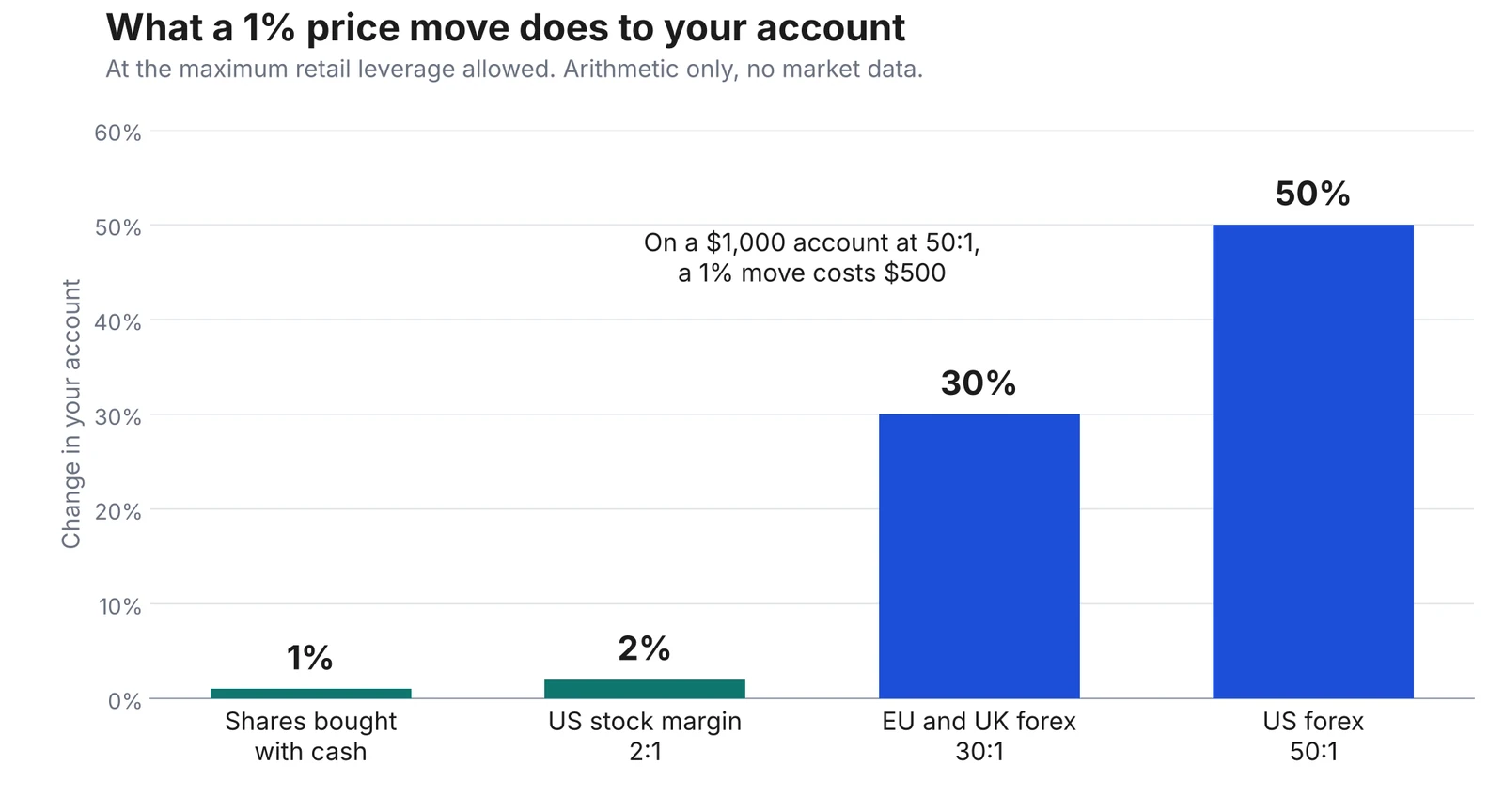
Each bar assumes the maximum leverage allowed. Arithmetic only.
Leverage doesn't make a bad trade good; it makes a bad trade expensive faster. Before your trade live, work out your margin with our forex margin calculator.
What moves each market?
Forex is a macro market. Currencies react to central bank decisions, interest rates, inflation, jobs data, and politics. When the US Federal Reserve indicates higher rates, the dollar tends to rise against most currencies at once. Our economic calendar lists the releases that move them.
Stocks respond to the company first. An earnings beat lifts a share; a failed drug trial can sink a biotech stock in a day. Macro news matters too, but differently: fears of a US recession tend to weigh on US shares and lift safe-haven currencies such as the Japanese yen and Swiss franc. If you enjoy following central banks, go for forex. If you prefer to study businesses, stocks fit better.
Regulation and investor protection
Forex has no single regulator, because trades happen between banks and dealers. Each country oversees its own brokers: the CFTC and the National Futures Association in the US, the FCA in the UK, national regulators in the EU, and ASIC in Australia. Standards vary, so choose a broker licensed in a strong jurisdiction.
US stocks are covered by one set of rules. The SEC oversees the exchanges, and FINRA oversees brokers. If a US brokerage fails, SIPC restores missing cash and securities up to $500,000, including $250,000 in cash. SIPC doesn't cover market losses, and its page says it doesn't protect foreign exchange trades. Before you open any account, check the broker on its regulator's register; for US brokers, our FINRA BrokerCheck guide shows you how.
Volatility and trading styles
A single stock can move more in a day than a major currency pair. A tech share can jump or drop 10% on earnings. EUR/USD often moves well under 1% on a normal day. Leverage changes the picture: a 0.5% move at 30:1 is a 15% swing in your account.
Forex suits short-term styles: scalping, day trading, and swing trading, helped by the long hours. Stocks suit both ends. Day traders work individual shares, and long-term investors hold them for years and collect dividends. Holding forex for months is possible through carry trades, where you earn or pay the interest gap between two currencies each night, but that depends on interest rates staying where you expect.
Profitability: what the numbers show
Most retail traders lose money in both markets. When EU regulators studied their data in 2018, 74-89% of retail CFD accounts lost money, ESMA said. In 2016, the UK's FCA found that 82% of clients in a sample of CFD accounts lost money. Active stock day trading carries similar risks.
Patient stock investors have done better. From 1928 to 2025, the S&P 500 returned about 10% a year with dividends reinvested, according to data from NYU Stern's Aswath Damodaran. Warren Buffett wrote the same idea into his will, in his instructions to the trustee of his wife's inheritance:
"Put 10% of the cash in short-term government bonds and 90% in a very low-cost S&P 500 index fund."
— Warren Buffett, 2013 letter to Berkshire Hathaway shareholders
In either market, results depend more on position size, risk control, and discipline than on the market you pick.
Which is better for beginners?
We'd advise most beginners to start with stocks, for four reasons:
- Lower leverage keeps early losses small as you learn.
- Familiar companies are easier to research than central bank policy.
- Set hours give you a routine and limit late-night decisions.
- Slower margin calls give you more room to be wrong before a position is closed.
Forex has clear advantages: long hours, high liquidity and small minimum deposits. The leverage that comes with them punishes beginners more. If you start with forex, practise on a demo account for at least three months, keeping in mind how demo and live trading differ. Then trade micro lots and decide how much to risk per trade before you open a position.
Forex Trading vs Stock Trading: The Bottom Line
Forex fits you if you want to trade outside office hours, follow central banks, and handle leverage with care. Stocks suit you if you prefer to research companies, collect dividends, and trade during the day. Regardless of what you choose, you need to practise on a demo first, size every position to a loss you can afford, and check your broker on its regulator's register before you deposit.
Frequently Asked Questions
Is forex trading better than stock trading?
Neither is better for everyone. Forex suits traders who want long hours and accept leverage; stocks are for people who want ownership, dividends, and lower leverage.
Is the forex market bigger than the stock market?
Yes, it is in terms of daily trading: about $9.6 trillion a day in currencies (BIS, 2025) against around $800 billion a day in shares on the world's exchanges (WFE, 2025).
Is forex riskier than stocks?
Yes, it is for most retail traders, because of leverage. At 50:1, a 1% move can cost half your account; shares bought with cash can't lose more than you paid.
Can I trade both forex and stocks?
Yes, and many traders do. Check what each account holds, because a broker's 'stocks' may be share CFDs, and check which company and regulator stand behind each account.
Is the stock market safer than forex?
Yes, it is generally safer for US investors. Stock accounts use less leverage, and SIPC protects them if a brokerage fails. SIPC excludes forex trades. But neither can protect you from market losses.